
Reviewed · WALKING TOURS
German Footprint & Nazi presence – Walking Tour in Bariloche
History hides in plain sight here. This 90-minute walk connects Bariloche’s German-speaking roots with the darker Nazi chapter that followed, using the town center as its classroom. I like the clear, story-led teaching and the chance to see ordinary streets and buildings through a more serious historical lens. The main caution is that the walk includes uphill sections, street noise, and possibly a larger group than expected.
I also like the timing. At about $41 per person, this is a short tour, but it gives you a useful introduction to Bariloche before you spend your days on lakes, trails, snow, or mountain roads. Guides Diego and Federico have been praised for their English, thoughtful answers, and ability to explain difficult material without turning the subject into spectacle.
In This Review
- Key points about the Bariloche history walk
- Why this short walk adds depth to Bariloche
- Meeting at Centro Civico, Bariloche’s civic heart
- Club Andino Bariloche and the town’s German connections
- The Primo Capraro Institute and a shift in German influence
- Plaza Belgrano and the most difficult part of the story
- What the walking itself is like
- The guide can make or break this experience
- Is $41 a fair price for 90 minutes?
- Who should book this Bariloche walking tour?
- Final verdict: book it for history, not just sightseeing
- FAQ
- How long does the German Footprint and Nazi Presence walking tour last?
- How much does the tour cost?
- Where does the tour start?
- Where does the tour end?
- Is this a private tour?
- What places does the tour visit?
- Does the price include admission tickets?
- Is the tour conducted in English?
- Is the tour suitable for people with mobility issues?
- Can I cancel the booking for a refund?
Key points about the Bariloche history walk
- German-speaking origins: Learn how immigration helped shape Bariloche’s early development and identity.
- Four central stops: The route links Centro Civico, Club Andino Bariloche, the Primo Capraro Institute, and Plaza Belgrano.
- A serious Nazi-era discussion: The tour addresses Germans who settled in Argentina and Bariloche after World War II.
- Strong English presentation: Diego is especially praised for clear English, storytelling, and careful answers to questions.
- Compact city route: The walk covers roughly ten blocks and takes about 1.5 hours, with some uphill stretches.
- Private booking, group-size caution: The activity is described as private, though one account noted a group of about 40, so it is wise to confirm the expected size.
Why this short walk adds depth to Bariloche
Bariloche is easy to enjoy at the surface level. You can admire the lake, eat chocolate, browse the civic center, and head into the mountains. This tour asks you to slow down and consider how the town got its particular look and identity.
The focus is not simply German architecture or European-style food. It is the story of German-speaking immigration, the town’s early formation, and the political shadows linked to people who arrived after the Second World War. That makes the experience more demanding than a standard sightseeing stroll, but also more useful if you want to understand Bariloche rather than just photograph it.
I appreciate the way the subject is handled. The material includes controversy, but the guide is expected to present facts and context rather than offer easy sensationalism. Diego, in particular, is praised for a calm and engaging style. He explains the subject with suspense and drama, yet also responds thoughtfully when the group asks difficult questions.
That balance matters. A tour about Nazi presence can easily become lurid or careless. Here, the aim is to explain how European migration, local development, and postwar history intersected in Argentina. You should come ready to listen, ask questions, and accept that the story is not tidy.
The walk also gives you a useful introduction to central Bariloche. One participant described it as a good choice at the beginning of a stay because it combined a history lesson with an overview of the city. I agree with that timing. Once you understand the role of the central buildings and neighborhoods, later walks through town have more meaning.
More walking tours in Bariloche:
- Bariloche: German Immigration and History Walking Tour
★ 4.8 · 169 reviews - Nahuel Huapi Lake Cruise with Victoria Island and Arrayan Forest Walk
★ 3.5 · 50 reviews - Buenos Aires Hop-On Hop-Off Bus, Free Walking Tours & Discounts
★ 4.5 · 2,218 reviews
Meeting at Centro Civico, Bariloche’s civic heart
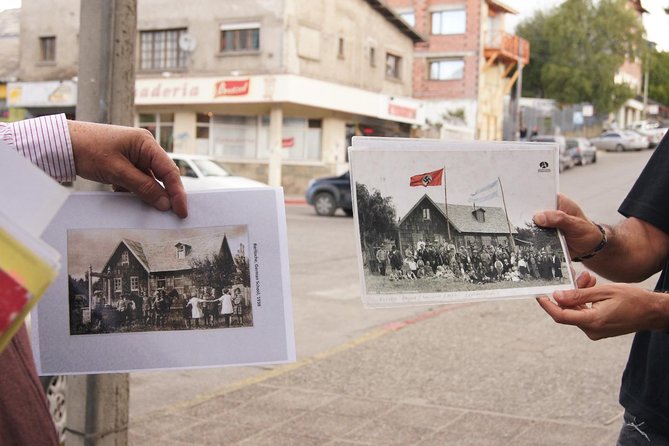
The tour starts at the Secretaría de Turismo Bariloche, at Libertad 56, near Centro Civico. The civic center is the first stop and takes about 15 minutes.
This is where the guide begins the larger story of Bariloche’s foundation and the role of German-speaking immigration. Instead of treating the city as a collection of postcard views, the discussion places its early growth within the movement of people, ideas, and institutions from the German-speaking world.
Centro Civico works well as an opening point because it gives you a familiar public setting before the route moves toward more specific sites. You will hear about where, when, and how German-speaking immigrants influenced the town’s beginnings. The stop is free, so there is no admission cost to consider at this stage.
The value here is context. Without it, later references to German neighborhoods, clubs, schools, and buildings can feel disconnected. With it, you begin to see the town center as a record of migration and civic ambition.
The guide’s presentation makes a real difference. Diego has been praised for speaking clearly in English and for bringing the subject to life with facts and visual references. The tour is not designed as a silent architecture walk, so stay close and listen carefully, especially if traffic or other pedestrians create noise.
Club Andino Bariloche and the town’s German connections
The second stop is outside Club Andino Bariloche, usually called CAB, and takes around 15 minutes. Admission is not included, and the stop is conducted from outside the historic house.
This part of the route looks at the historic area and the role of German-speaking immigration in local institutions. The building is not just a backdrop. It helps the guide explain how the town’s social and civic life developed, and how European influences became part of Bariloche’s public identity.
You should not expect an indoor museum visit here. The strength of this stop is the explanation provided on the street, where the guide connects the building with the wider story. That also means the experience depends on your ability to hear and follow the talk in an open urban setting.
One practical concern is group size. The experience is presented as a private activity for your group, yet one account described a group of about 40 people and found it hard to hear over street noise. That may have been an unusual arrangement, but I would confirm the expected size before booking if close listening is important to you.
The Primo Capraro Institute and a shift in German influence
The third stop is outside the Primo Capraro Institute, with about 15 minutes devoted to it. Admission is not included.
This building marks what the tour describes as a key historical moment and a breakthrough in German influence in Bariloche and Argentina. The stop helps move the story beyond the simple idea that German immigrants merely arrived and settled. It points to the ways influence expanded through institutions and local life.
That is one of the tour’s better features. You are not given a single explanation for Bariloche’s character. Instead, the guide traces changes over time and shows how different stages of immigration affected the town.
The stop is also a reminder that historical influence can be complicated. Cultural traditions, civic development, and political associations do not always fit into neat categories. The guide’s job is to explain those connections without suggesting that every German-speaking immigrant shared the same politics or intentions.
As with CAB, you remain outside the building. If you want entry to a particular site, this tour is not promising that. Its purpose is an escorted historical walk, not a series of interior visits.
A few more Bariloche trips worth putting side by side
- Bariloche: 7 Lakes & San Martin de Los Andes Road Trip
★ 4.5 · 624 reviews - Bariloche: Circuito Chico with optional Cerro Catedral
★ 4.5 · 316 reviews - Fly Fishing Bariloche
★ 5.0 · 305 reviews - San Martín de los Andes por 7 Lagos
★ 4.4 · 155 reviews
Plaza Belgrano and the most difficult part of the story
Plaza Belgrano is the longest stop, at about 30 minutes. It is described as the heart of the German neighborhood, with houses and sites linked to German and Nazi presence in Bariloche.
This is where the tour’s central subject receives its fullest treatment. The guide discusses the German community, the neighborhood’s related buildings, and the arrival of Nazis in Argentina and Bariloche after World War II.
For many people, this will be the most compelling part of the walk. It connects the earlier discussion of immigration with the controversial postwar chapter that gives the tour its title. You will likely hear about the difference between ordinary German-speaking settlement and the presence of Nazi fugitives or supporters. That distinction is important, and a good guide should keep it clear.
The subject is unsettling, but the presentation is not described as exploitative. Diego is praised for being factual, respectful, and willing to address controversy directly. Several people found his storytelling captivating, while others valued the thoughtful way he answered questions. That combination should suit you if you want historical explanation rather than a sensational crime story.
Plaza Belgrano also gives you time to look at the area itself. The houses and sites matter because they make the past visible in the present. You are not only hearing about names and dates. You are standing in a neighborhood connected to the story.
Still, keep your expectations realistic. This is a 30-minute outdoor discussion, not a full academic seminar or museum archive. The tour offers an overview and a guided interpretation. If you want detailed research on every individual or building, you will need to continue your own reading afterward.
What the walking itself is like
The route is compact, covering about ten blocks, but it is not entirely flat. Some sections are slightly uphill, and the walk is not a good fit if you have serious difficulty with inclines or walking.
The total duration is about 1 hour and 30 minutes. That is long enough to build a coherent story but short enough to fit around meals, museum visits, or other plans. You will spend much of the time listening outside buildings and walking between stops, so wear comfortable shoes and dress for Bariloche’s weather.
The tour can be a useful break from snow sports and resort activities. You do not need to commit half a day to history, and you return to the same meeting point at the end. That makes it easy to place into a busy Bariloche schedule.
Public transportation is nearby, and most people can participate. The meeting point is the tourist information office at Libertad 56. Since the activity starts and ends there, you do not have to arrange a separate ride back from an outlying neighborhood.
Street conditions matter. One account found that a large group and traffic noise made it difficult to catch every word. Stay near the guide, and ask to move closer if you cannot hear. A smaller group should make the experience more personal and help you ask questions without losing the thread of the story.
The guide can make or break this experience
This tour depends heavily on the person leading it. The locations are interesting, but the story is what turns a walk through central Bariloche into a serious historical experience.
Diego receives especially strong praise for his English, delivery, and command of the subject. He is described as an excellent storyteller who speaks clearly and presents an unbiased account. The experience has also been led by Federico, who is praised for answering questions and explaining the history in an engaging way.
You should expect a guide who talks often and gives the walk its shape. This is not a tour where you simply take photographs and receive a few brief facts. The best moments come from the links between places, dates, immigration waves, and political events.
I would book this if you enjoy asking questions. The subject raises natural questions about identity, responsibility, migration, and memory. The guides appear comfortable with that kind of discussion, which adds value beyond a memorized speech.
English ability is another strong point. The English-speaking guide is described as easy to understand, with excellent or impeccable English. That is important here because the material includes names, historical periods, and distinctions that can be lost when explanations are rushed or unclear.
Is $41 a fair price for 90 minutes?
At $41 per person, this is not the cheapest way to spend an hour and a half in Bariloche. The value depends on what you want from a tour.
If you only want a quick orientation to the civic center, the price may feel high. You can walk through central Bariloche on your own. But you would miss the connected explanation of German-speaking immigration, the institutional sites, and the postwar Nazi presence.
I think the price is reasonable for a private or small-group historical walk led in clear English, especially if you care about the topic. The guide’s preparation and storytelling are the main product. You are paying for interpretation, not entry tickets or transport.
The value is also higher if you take it early in your visit. It gives you a basic map of central Bariloche while adding background that can improve later sightseeing. If you are interested in history, the tour offers more substance than a general orientation walk.
The main value concern is group size. A private experience should feel personal, but a group of around 40 would make it harder to hear and ask questions. Confirm this detail before paying, particularly because the published format says only your group will participate.
Who should book this Bariloche walking tour?
I would recommend it to you if you enjoy local history, migration stories, political history, or guided walks that tackle uncomfortable subjects. It is also a good fit if you want to understand why Bariloche has such a strong European influence before heading into the surrounding mountains.
Families can enjoy it if older children or teenagers are ready for a serious discussion of Nazism and postwar migration. Couples and solo visitors who like asking questions should find the format rewarding.
I would be more cautious if you want a light, cheerful introduction to town. The walk covers a troubling subject, and the guide does not avoid the controversial parts. It is also not ideal if you have difficulty walking uphill or hearing in a noisy street setting.
The tour is recommended by 98 percent of participants and carries a 4.9 rating from 337 reviews. Those figures match the consistent praise for the guides’ presentation, English, storytelling, and historical depth. Still, a high rating does not remove the practical concerns about hills, outdoor listening, and possible group size.
Final verdict: book it for history, not just sightseeing
Book this tour if you want Bariloche to make more sense. In 90 minutes, it links the civic center, historic institutions, a German neighborhood, and the Nazi chapter that still gives the town a complicated reputation.
I especially value the respectful tone, the strong English delivery from guides such as Diego and Federico, and the way the route uses real streets and buildings rather than treating history as an abstract lecture. The short length and central meeting point make it easy to fit into your plans.
Skip it if you are looking only for scenery, shopping, or a casual city stroll. For everyone else, particularly history-minded visitors, this is a thoughtful use of an hour and a half. Book it near the start of your Bariloche stay, confirm the group size, wear good shoes, and stay close enough to hear the story.
FAQ
How long does the German Footprint and Nazi Presence walking tour last?
The tour lasts approximately 1 hour and 30 minutes.
How much does the tour cost?
The price is $41 per person.
Where does the tour start?
It starts at Secretaría de Turismo Bariloche, Informes Turísticos, Libertad 56, San Carlos de Bariloche.
Where does the tour end?
The activity ends back at the original meeting point.
Is this a private tour?
The activity is described as private, with only your group participating. Since one account noted a group of about 40, confirm the expected group size before booking.
What places does the tour visit?
The route includes Centro Civico, Club Andino Bariloche, the Primo Capraro Institute, and Plaza Belgrano.
Does the price include admission tickets?
Centro Civico has free admission. The stops at Club Andino Bariloche, the Primo Capraro Institute, and Plaza Belgrano are listed without included admission tickets.
Is the tour conducted in English?
An English-speaking guide leads the tour. Diego is specifically praised for excellent English, and Federico has also led the experience.
Is the tour suitable for people with mobility issues?
The route covers about ten blocks and includes some uphill walking. It is not well suited to people with ambulatory difficulties.
Can I cancel the booking for a refund?
The experience is non-refundable and cannot be changed after booking. If the operator cancels because the minimum number of participants is not met, you will be offered another date or experience, or a full refund.
Recently added around Bariloche
- Snow excursion in Bariloche – Suitable for the whole family★ 4.5 · 3 reviews
- MATE tasting ceremony – (Argentina traditional tea)★ 5.0 · 2 reviews
- Exclusive Sailboat Trip through the Lakes of Bariloche★ 4.0 · 9 reviews
- Snow Baptism Adventure: Skiing and Snowboarding at Cerro Catedral★ 4.0 · 5 reviews
- Transfer from the Airport to Bariloche★ 3.5 · 4 reviews
- Camino de los siete Lagos, bilingüe★ 4.0 · 4 reviews
- GERMAN TREKKING TO BERGHOF – Mountain stories★ 4.5 · 4 reviews
- 10 Secrets of Bariloche, Nahuel Huapi, and Patagonia★ 5.0 · 46 reviews
Walking Tours, compared.
Buenos Aires Hop-On Hop-Off Bus, Free Walking Tours & Discounts
Read our review →
Full Day Buenos Aires Private Walking Tour – Your Own Personal BA 101
Read our review →
Discover Buenos Aires: Walking Tour Through San Telmo & Center!
Read our review →
Nazis in Buenos Aires: a historical walking tour
Read our review →Browse the lists this tour appears in