
Reviewed · WALKING TOURS
Buenos Aires Private Historical Downtown, San Telmo and La Boca Walking Tour
Buenos Aires reveals itself one street at a time. This private four-hour walk links the city center with San Telmo and La Boca, mixing famous sights with small architectural details and stories about politics, immigration, slavery, religion, and daily life. I like the private format, which lets your guide adjust the pace and answer questions, and I like the built-in coffee break at a traditional café.
The tour covers a remarkable amount, from the Obelisco and Teatro Colón to Casa Rosada, San Telmo, and La Boca. That is also the main concern: the pace can feel rushed, especially if you want time for photographs or a proper look inside the cathedral. One past participant felt the tour lasted only two hours, so confirm the start time and planned route when you meet your guide.
In This Review
- Key points before you book
- Starting among grand avenues and famous façades
- Architecture, shopping, and stories on Florida Street
- Plaza de Mayo, Casa Rosada, and the nation’s difficult past
- Puerto Madero, a failed port turned modern district
- Casa Minima and the streets of San Telmo
- Parque Lezama and the colorful streets of La Boca
- What four hours and $125 really buy you
- Who will enjoy this Buenos Aires walk
- Should you book it?
- FAQ
- How long is the walking tour?
- What neighborhoods does the tour visit?
- Where does the tour start?
- Where does the tour end?
- Is coffee included?
- Is hotel pickup provided?
- Is this a private tour?
- Can children join the tour?
- Does the tour operate in bad weather?
Key points before you book
- Twenty major stops in about four hours: Expect a fast-moving introduction to central Buenos Aires rather than long visits inside each attraction.
- A genuinely private experience: Only your group takes part, with an English-speaking guide and room for questions.
- Coffee is part of the plan: The included café stop adds a welcome pause and a taste of old Buenos Aires café culture.
- The route connects three very different districts: Downtown brings grand civic buildings, San Telmo brings cobblestones and colonial architecture, and La Boca brings colorful streets and tango.
- Good walking shoes matter: The distance, stop count, and four-hour schedule call for comfortable footwear.
- Weather and city events can change the day: The tour runs rain or shine, but strikes, repairs, demonstrations, or other disruptions may limit the full route.
Starting among grand avenues and famous façades
The meeting point is outside Petit Colón at Libertad 505, close to the Teatro Colón. That is a useful starting place because you begin near one of Buenos Aires’ great cultural landmarks, not in a generic hotel district. The tour is near public transportation, though hotel pickup and drop-off are not included.
The first stretch introduces the city through monumental buildings and broad avenues. At the Obelisco, your guide explains why this tall white monument was built in 1936 to mark the 400th anniversary of the city’s first foundation. It rises at the junction of Avenida Corrientes and Avenida 9 de Julio, one of the world’s widest avenues.
Five minutes at the Obelisco is enough for orientation and photographs, but not for a long visit. The value is in hearing how the monument became a national symbol and in understanding the scale of central Buenos Aires. Corrientes is also tied to the city’s theater, books, pizza, and late-night culture, so this quick stop can open a larger conversation about urban life.
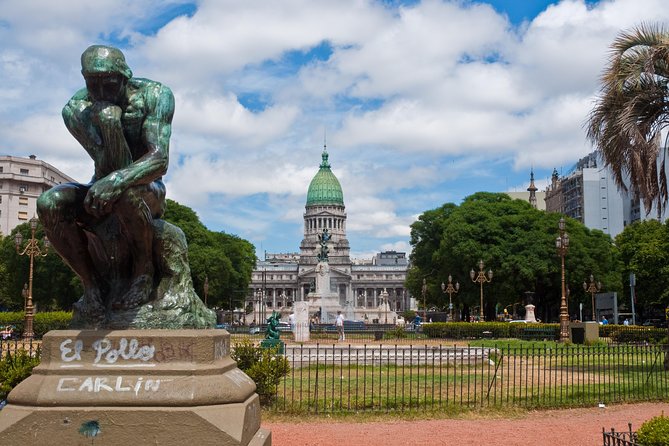
From there, you pass the Palacio de Tribunales, home to the Supreme Court and other courts. The exterior is imposing, and the building offers a chance to discuss Argentina’s political and legal institutions. The stop is brief, so expect an explanation from the pavement rather than an interior tour.
The Teatro Colón follows. Buenos Aires takes its opera seriously, and this theater is widely regarded as one of the world’s finest opera houses. Five minutes will not reveal its famous interior, but the building is an important marker of the city’s cultural ambition. If you are hoping to see a performance or take a formal theater tour, arrange that separately.
More History Tours in Buenos Aires
- Historical Sherpa Food Tour of San Telmo with Street Food, Drinks
★ 5.0 · 920 reviews - Nazis in Buenos Aires: a historical walking tour
★ 4.9 · 193 reviews - San Telmo: Historical Guided Tour with Street Food & Drinks
★ 5.0 · 87 reviews
Architecture, shopping, and stories on Florida Street
The next section moves through several elegant buildings near Florida Street. At the Teatro Nacional Cervantes, you hear about Argentina’s national stage and comedy theater, including its connection to Spain’s royal family. The guide also points out an unusual feature of the building and explains where the stage is located. That kind of small detail is exactly what can make a walking tour worthwhile.
Calle Florida is a pedestrian street with a very different mood from the grand avenues. Its past includes the only Harrods branch ever built outside London, the first singing of Argentina’s national anthem, and the ornate Galerías Pacífico shopping center. You have about ten minutes here, enough to get a sense of the street and hear its story, though not enough for serious shopping.
The Centro Naval provides one of the tour’s more unusual architectural details. Its Art Nouveau entrance was made from bronze obtained by melting down cannons used during Argentina’s independence battles. That link between military history and decorative design is easy to miss if you walk by alone.
At Galerías Pacífico, look upward. The Beaux-Arts building was designed by French architects in 1889 for a store modeled on Paris’ Le Bon Marché. It was later turned into a high-end shopping center, with striking ceiling murals and polished public spaces. The tour identifies George Soros as part of its 1990 redevelopment, giving you a quick lesson in how Buenos Aires has repeatedly reused grand older buildings.
This is one place where the schedule may feel tight. If you want to study the murals, browse the shops, or take detailed photographs, you will need to return later.
Plaza de Mayo, Casa Rosada, and the nation’s difficult past
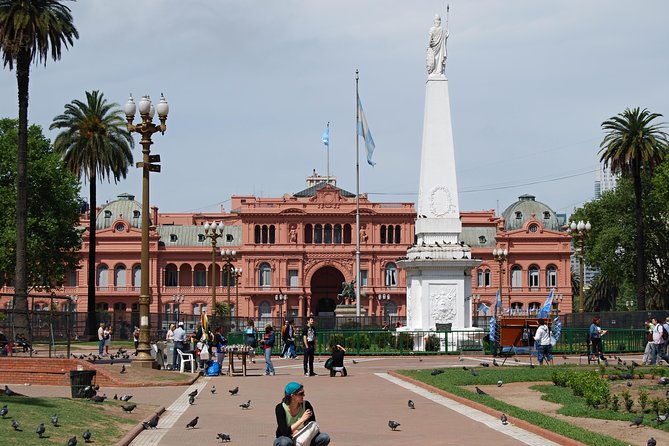
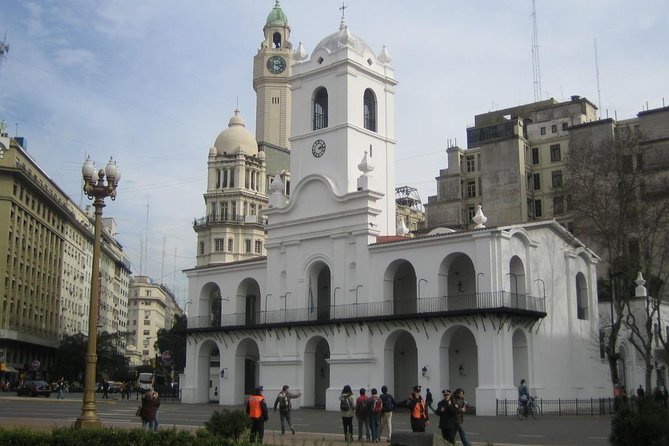
The tour reaches its strongest historical section at Plaza de Mayo, the political heart of Buenos Aires. This is where the city was founded, where major national events unfolded, and where the presidential Casa Rosada faces the square.
Your guide explains the Mothers of the Disappeared, whose weekly presence in the plaza became one of Argentina’s most powerful public reminders of the people lost during the country’s military dictatorship. This is not just a sightseeing stop. It is a place where architecture, protest, memory, and present-day politics meet.
The Casa Rosada is the office of Argentina’s president and one of the city’s most recognizable buildings. Its pink color has inspired many explanations, and the building also contains a museum with objects linked to former presidents. The tour gives you about ten minutes here, so expect an exterior explanation unless access to the museum has been arranged separately.
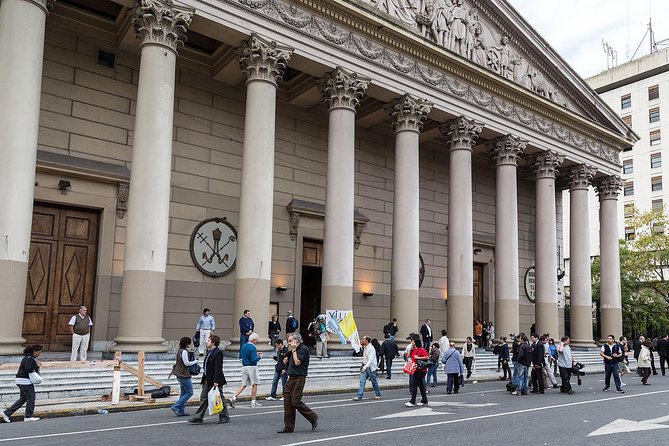
At the Metropolitan Cathedral, the focus shifts to religion and national independence. Pope Francis served here as bishop before becoming pope, and General José de San Martín, one of South America’s great liberators, is buried inside.
The cathedral stop deserves special attention because one past participant felt there was not enough time to see it properly beyond San Martín’s tomb. If church interiors matter to you, tell your guide early. The listed schedule includes fifteen minutes at the cathedral and ten minutes at the mausoleum, but the overall route has many competing stops.
The May Pyramid, located in the center of Plaza de Mayo, is the city’s oldest national monument. Your guide explains its meaning and changing role in public life. Then, at the Mausoleum of General José de San Martín, you hear the unusual story behind his tomb and learn more about the liberator himself.
This part of the tour is where a good guide adds real value. Joaquín was praised for explaining both the city’s past and current issues, while Soledad was noted for making Buenos Aires understandable through local perspective rather than dates alone. Guide quality can vary, but these details suggest the experience works best when you ask questions and engage in conversation.
Puerto Madero, a failed port turned modern district
The walk also includes Puerto Madero, a former port project that went badly wrong. The national government hired businessman Eduardo Madero in 1882 to build a new port, but the result soon proved impractical.
In recent decades, the area has been redeveloped with fashionable buildings and modern design. The contrast is useful: older Buenos Aires often appears through churches, palaces, and cobblestones, while Puerto Madero shows the city trying to remake itself.
The stop is only about ten minutes, so do not expect a full tour of the district. Instead, use it as a quick lesson in urban change. The area may also add walking time and make the route feel ambitious, particularly if the group pauses often in the downtown section.
More Private Tours in Buenos Aires
- Buenos Aires City Private Tour with Local Guide
★ 5.0 · 3,475 reviews - Private Airport Transfer In or Out : Ezeiza (EZE) – Buenos Aires
★ 5.0 · 548 reviews - Private Full-Day Iguazu Falls Tour with Airfare from Buenos Aires
★ 4.5 · 387 reviews - Private City Tour with a friend in Buenos Aires
★ 5.0 · 363 reviews
Casa Minima and the streets of San Telmo
The transition to San Telmo brings a smaller scale. At Casa Minima, you see what is described as the narrowest colonial house in Buenos Aires. Its story is linked to freed people after Argentina abolished slavery in 1812.
This is a valuable stop because it adds a social history often left out of grand-city sightseeing. The building is narrow and easy to miss, yet it opens questions about race, freedom, housing, and the people who built Buenos Aires.
From there, the route reaches Plaza Dorrego, the center of San Telmo’s antique trade and a lively meeting place lined with cafés and antique shops. The square once served as a stopping place for wagons before they crossed a stream on the way downtown. Its name changed several times before becoming Plaza Dorrego in 1905.
The square is also the stated end point at Humberto 1º 400. Since the listed route includes La Boca as well, ask your guide how the day will be organized. The exact order may change, and city conditions can affect the full coverage. If your tour ends at Plaza Dorrego, that is a convenient place to continue exploring San Telmo on your own.
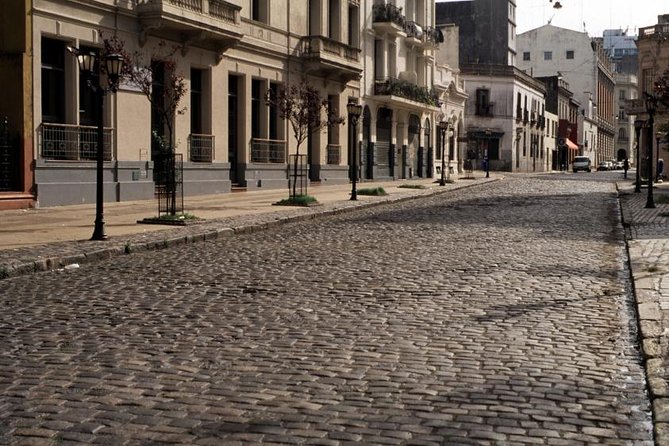
Calle Defensa links the downtown area with San Telmo and carries much of the district’s old character. Its cobblestones and preserved buildings make it more rewarding when you slow down, but the schedule allows thirty minutes here. That is enough for an introduction, not a leisurely antique hunt.
At the Parroquia de San Pedro González Telmo, your guide explains the church’s connection to the Jesuits, its former armory, and its later use as a women’s jail. The church also served sailors and played a role during the first British invasion in 1806.
The Pasaje de la Defensa gives you a closer look at former domestic architecture. The old Ezeiza family mansion was restored in 1980, and similar buildings in San Telmo had often become conventillos, or shared tenements, from the 1870s onward. This helps you see the neighborhood as more than an attractive set of old façades. Its buildings also tell the story of overcrowding, migration, and changing city life.
Parque Lezama and the colorful streets of La Boca
At Parque Lezama, you reach a place connected with the earliest Spanish attempt to establish Buenos Aires. Historians believe Pedro de Mendoza landed near the park’s eastern slope in 1536. The settlement failed, but the site gives the tour a useful starting point for the city’s long and difficult colonial story.
The park stop is short, only about five minutes. You will hear the basic history and see the monument, but you will not have time for a full park visit.
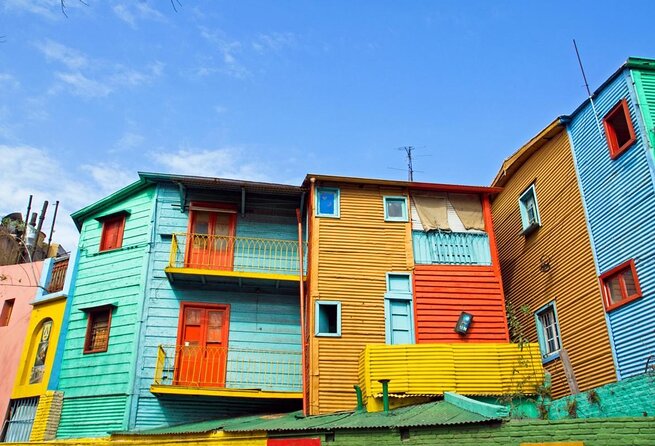
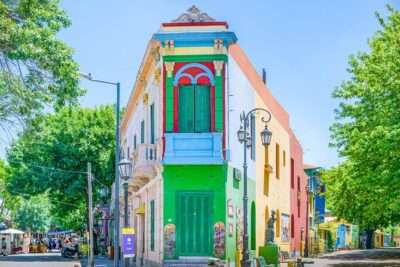
The final major district is La Boca, known for colorful houses, the pedestrian Caminito, tango performances, tango souvenirs, theaters, clubs, and Italian taverns. The forty-five-minute allocation makes this one of the more substantial stops.
La Boca is a place to look closely, but also to keep your expectations realistic. Caminito is highly arranged for sightseeing, with bright buildings and performers competing for attention. It can feel commercial, yet it remains an important expression of the neighborhood’s association with tango, Italian immigration, and working-port culture.
You will have time to take photographs and hear how the area developed. You may also find that the short visit leaves you wanting more. If tango, street art, or La Boca’s social history interests you, consider returning independently during daylight hours. The tour gives you context, which helps you decide where to spend more time later.
What four hours and $125 really buy you
At $125 per person, this is not a budget stroll. The price makes more sense if you value a private guide, English explanations, and the ability to ask about details that interest you. A small group also means you are not waiting for a large crowd to cross streets or gather around a guide.
The tour covers twenty stops, but many receive only five or ten minutes. I would treat the experience as a carefully packed orientation to Buenos Aires, not as twenty complete visits. You pay for connections between places: why the Obelisco matters, how the cathedral relates to San Martín and Pope Francis, why San Telmo’s old houses look the way they do, and how La Boca became a symbol of tango.
The included coffee break improves the value. One participant specifically enjoyed a cortado in an old, traditional café, and that pause gives the tour a more local rhythm. Other food and drinks are not included, so budget for lunch and any extra café purchases.
The tour requires at least two people to operate, and children under eight are free when accompanied by an adult. Most people can take part, but you should be ready to walk for four hours. Comfortable shoes are not optional here.
Who will enjoy this Buenos Aires walk
I would recommend it most strongly for a first visit to Buenos Aires. You get the city’s major symbols, a useful introduction to its political past, and a first look at neighborhoods that feel very different from one another.
It also suits people who prefer conversation over museum interiors. The guides Joaquín and Soledad were praised for explaining architecture, historical events, and present-day Argentina in an approachable way. The private setting gives you a better chance to ask about cafés, neighborhoods, and what to see next.
It is less suitable if you want a slow photographic walk. The cathedral, Galerías Pacífico, San Telmo, and La Boca all deserve more time than the schedule allows. It may also disappoint anyone expecting every listed stop to receive equal attention.
The tour runs rain or shine. Strikes, demonstrations, road repairs, or other city conditions can affect the route, and the full schedule is not guaranteed in every circumstance. Free cancellation is available up to 24 hours before the start time, but changes or cancellations inside that window are not refunded.
Should you book it?
Book this tour if you want a private, fact-filled first look at Buenos Aires and you are happy to keep moving. The strongest reasons are the English-speaking guide, the broad range of neighborhoods, the political and social context at Plaza de Mayo and San Telmo, and the café break.
I would skip it if you want long interior visits, extended time at each photo stop, or a relaxed four-hour stroll. Before setting out, confirm whether La Boca is included in the same route and how the listed ending at Plaza Dorrego fits into the day.
For most first-time visitors, the tour offers a useful framework. You will leave knowing which places deserve a second visit, and that is often the best job a city walk can do.
FAQ
How long is the walking tour?
The tour lasts approximately four hours.
What neighborhoods does the tour visit?
It covers historic downtown Buenos Aires, San Telmo, and La Boca. It also includes Puerto Madero.
Where does the tour start?
The meeting point is Petit Colón at Libertad 505, C1012 Buenos Aires.
Where does the tour end?
The stated end point is Plaza Dorrego at Humberto 1º 400 in San Telmo.
Is coffee included?
Yes. A coffee break is included. Other food and drinks are not included.
Is hotel pickup provided?
No. Hotel pickup and drop-off are not included.
Is this a private tour?
Yes. Only your group participates in the activity.
Can children join the tour?
Yes. Children under eight are free when accompanied by an adult.
Does the tour operate in bad weather?
Yes. It operates rain or shine, though weather and city conditions may affect coverage of the full route.
More Walking Tours in Buenos Aires
- Buenos Aires Hop-On Hop-Off Bus, Free Walking Tours & Discounts
★ 4.5 · 2,218 reviews - Buenos Aires: La Boca Guided Walking Tour in English
★ 4.8 · 1,587 reviews - La Boca Walking Tour
★ 5.0 · 1,029 reviews - Recoleta Cemetery Walking Tour
★ 5.0 · 668 reviews
Recently added around Buenos Aires
- Photo Session in Buenos Aires★ 5.0 · 26 reviews
- Your Personal Photographer in Buenos Aires★ 5.0 · 24 reviews
- Discover Buenos Aires’ independent art scene — Ticket included★ 5.0 · 30 reviews
- Your Private Photographer in Buenos Aires★ 5.0 · 4 reviews
- Yerba Mate Workshop – Learn to Drink Mate like a Local!★ 5.0 · 11 reviews
- Taste of Tradition: Yerba Mate & Alfajores Experience★ 4.0 · 5 reviews
- Wine tasting in OASIS Palermo★ 5.0 · 2 reviews
- Day Tour Classic★ 3.5 · 35 reviews
Walking Tours, compared.
Buenos Aires Hop-On Hop-Off Bus, Free Walking Tours & Discounts
Read our review →
German Footprint & Nazi presence – Walking Tour in Bariloche
Read our review →
Full Day Buenos Aires Private Walking Tour – Your Own Personal BA 101
Read our review →
Discover Buenos Aires: Walking Tour Through San Telmo & Center!
Read our review →
Browse the lists this tour appears in