
Reviewed · WALKING TOURS
Walking Tour of the Plaza de Mayo in Buenos Aires
Buenos Aires tells its story in public squares. This two-hour walk connects the city’s political center with its colonial past, grand avenues, and everyday civic life. I like the small group of up to 10 people, which should make it easier to hear the guide and ask questions. I also like the route’s clear focus, from Plaza de Mayo to the cathedral, Cabildo, and Avenida de Mayo.
The main consideration is the price: $61.80 per person is not a budget stroll. You are paying for a professional local guide and a short, focused introduction to central Buenos Aires, not for admissions or hotel transfers. Uneven surfaces also make this a poor fit if walking is difficult.
In This Review
- Key points to know before booking
- Why Plaza de Mayo is the right place to begin
- The Metropolitan Cathedral and Pope Francis connection
- The Cabildo and the colonial government
- Avenida de Mayo and the city’s grand public face
- What the small group format adds
- Is $61.80 a fair price?
- Timing, meeting point, and physical demands
- Who will get the most from this walk?
- Cancellation and booking flexibility
- Should you book the Plaza de Mayo walk?
- FAQ
- How much does the walking tour cost?
- How long does the tour last?
- What language is the tour offered in?
- Where does the tour begin?
- Where does the tour end?
- What is included in the price?
- Is hotel pickup and drop-off included?
- What should I know about cancellations and mobility?
Key points to know before booking
- Plaza de Mayo is the heart of the tour: You begin at Buenos Aires’ oldest and most important public square.
- Nicole received especially warm praise: One guest called her tour an excellent introduction to Argentina’s political and social life.
- The route includes three major landmarks: The Metropolitan Cathedral, the Cabildo, and Avenida de Mayo all add a different layer to the story.
- The tour stays small: A maximum of 10 people offers a more personal format than a large city walk.
- It is a true walking experience: Hotel pickup, drop-off, and admission tickets are not included.
- The price requires a value judgment: This makes the most sense if you want guided context early in your Buenos Aires stay.
Why Plaza de Mayo is the right place to begin
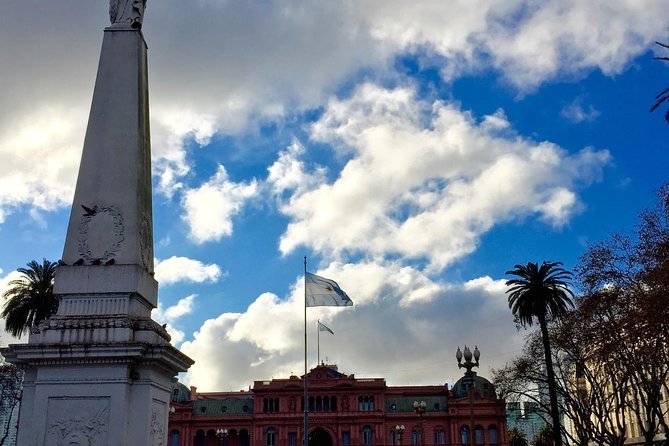
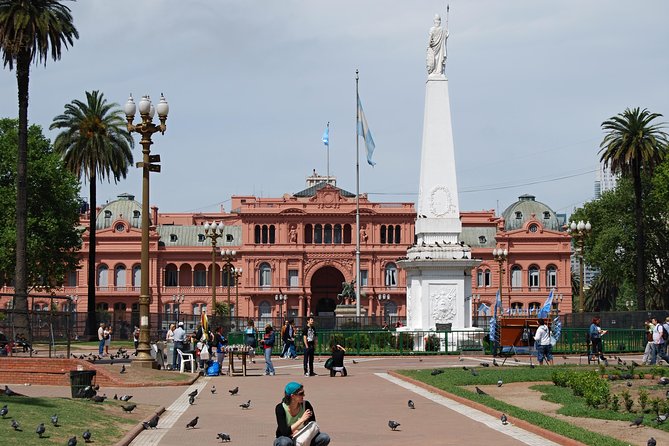
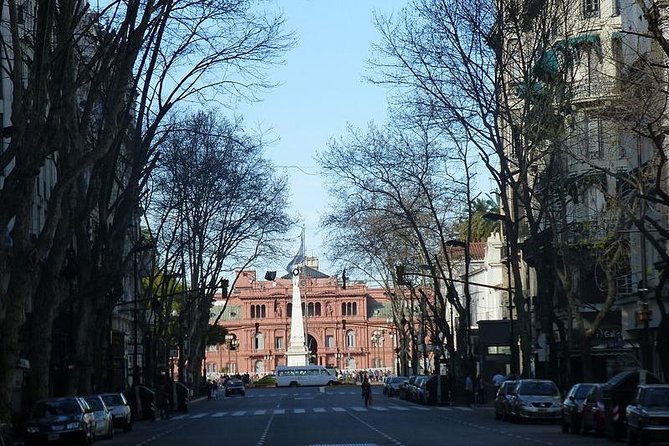
The tour starts at Bolívar 160 at 10:00 a.m., placing you close to Plaza de Mayo in the Monserrat area of central Buenos Aires. This is not just a convenient meeting point. The square is the city’s main stage for political gatherings, public celebrations, and major national events.
Plaza de Mayo also connects directly to the founding story of Buenos Aires. The square lies in the area associated with the city’s foundation, and its name recalls the May Revolution of May 25, 1810. On that date, local citizens gathered to remove the viceroy and form a creole government.
That single fact gives the opening stop real weight. You are not looking at a decorative plaza with a few monuments. You are standing in the place where Argentina’s break from Spanish colonial rule began to take shape.
The scheduled visit here lasts about 20 minutes, with no admission fee. That timing is short, but useful. A guide can give you a framework for understanding the square without turning the first stop into a long lecture. I like this approach because Plaza de Mayo works best when you connect its physical setting with the political events that took place there.
You should also expect the square to feel like a working civic space rather than a quiet museum courtyard. The information provided describes it as a silent witness to the country’s most important political and social events. That means its value comes from setting and explanation, not from an entrance exhibit or a formal attraction ticket.
A guide can help you notice why this location matters today as well as in the past. The tour’s strongest promise is that it links Argentina’s first foundations with modern city life. One guest particularly praised Nicole for showing how the square connects the first foundation of the city to Argentina’s life today.
More Walking Tours in Buenos Aires
- Buenos Aires Hop-On Hop-Off Bus, Free Walking Tours & Discounts
★ 4.5 · 2,218 reviews - Buenos Aires: La Boca Guided Walking Tour in English
★ 4.8 · 1,587 reviews - La Boca Walking Tour
★ 5.0 · 1,029 reviews
The Metropolitan Cathedral and Pope Francis connection
The Metropolitan Cathedral is directly in front of Plaza de Mayo, only a short walk from the Casa Rosada. Its location makes it an easy second stop, and the 20-minute visit keeps the pace moving.
The cathedral’s construction began in the seventeenth century and was completed only at the beginning of the twentieth century. That long building period helps explain why the current structure represents several stages of Buenos Aires’ development. It is not simply an old church. It is the country’s main Catholic house of worship and one of the central buildings around the square.
The most personal detail here is the cathedral’s connection to Pope Francis. Before becoming pope, he spent many years working and living in this setting. That gives the stop a direct link to a figure known around the world, while also showing how religious institutions fit into the city’s civic center.
I would treat this part of the walk as a compact architectural and cultural stop. You are not paying a separate admission fee, and the visit is not presented as an extended religious tour. Instead, the cathedral adds another point of view to the square: government, public protest, national identity, and faith all meet within a few steps.
The short time here may suit you if you prefer a walking tour with several locations. If you want a long interior visit or detailed architectural study, you may find 20 minutes limiting. The tour’s purpose is to place the cathedral in the larger story of Buenos Aires, not to examine every detail of the building.
The Cabildo and the colonial government
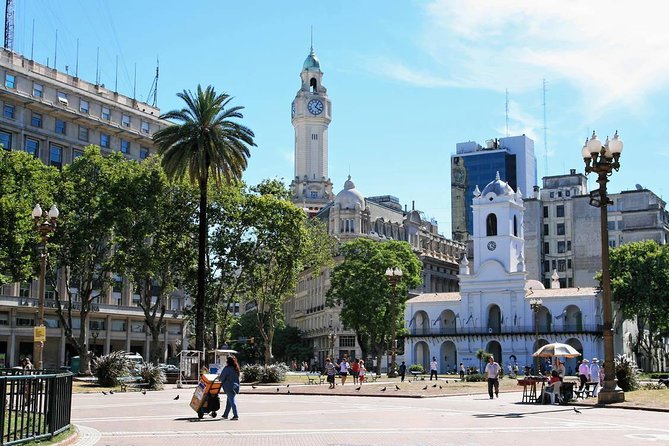
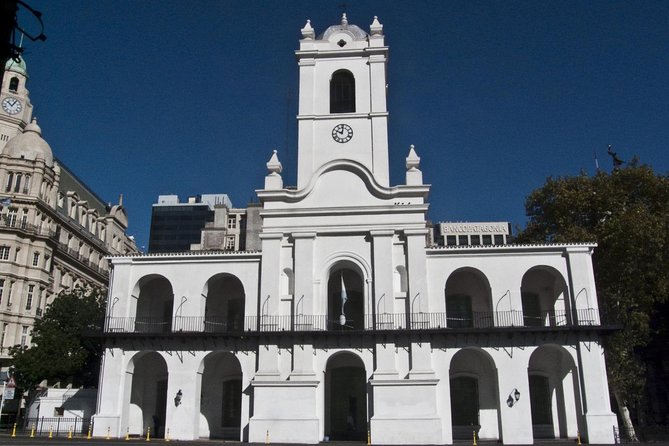
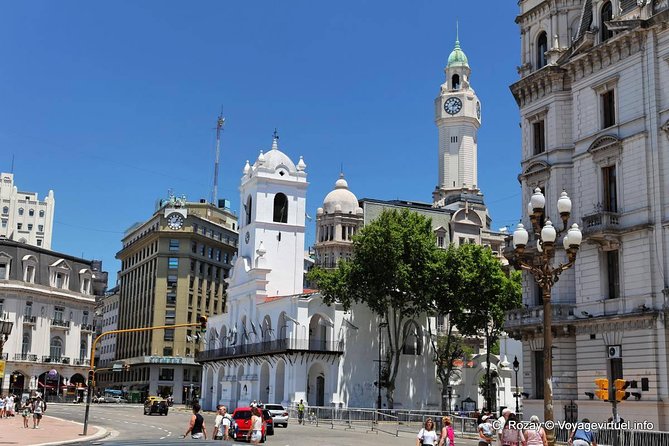
The Cabildo is located across from Plaza de Mayo, to the west, between Avenida de Mayo and Diagonal Sur, also called General Roca Street. Its position reinforces how tightly packed the city’s historic center is. The main landmarks are close enough to connect on foot, yet each represents a different period of public life.
This building began in colonial times as the seat of government representing the Spanish Crown. Its design and role imitated institutions in Spain, making it a useful counterpoint to the May Revolution discussed at the start of the walk.
The Cabildo helps you understand the political system that existed before the formation of a creole government. Without this stop, the story of 1810 could feel abstract. With it, you can place the former colonial authority directly across from the square where citizens gathered to challenge that authority.
The provided schedule does not list a separate duration for the Cabildo, so you should not expect a long standalone visit unless the guide’s pacing allows it. The tour returns to the central theme: Buenos Aires developed through arguments over who had the right to govern and whose interests the city should represent.
This is one reason a local guide adds value. A map can show you that the Cabildo faces Plaza de Mayo. A guide can explain why that location matters. The tour is strongest when buildings are treated as part of a story rather than as isolated photo stops.
Avenida de Mayo and the city’s grand public face
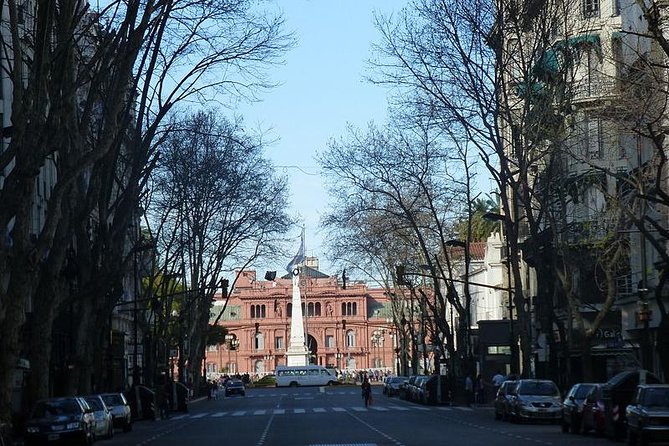
The final named stop is Avenida de Mayo, one of Buenos Aires’ major avenues. The route moves from the square’s political center into a broad urban setting lined with buildings that preserve the city’s older character.
The avenue is known for a mix of Art Nouveau, Belle Époque, and Art Déco facades. The Barolo Palace and the Real Estate Building are identified as two of its most important architectural examples. Even if you are not an architecture specialist, these styles give you a visual record of how Buenos Aires presented itself as a modern, cosmopolitan capital.
Avenida de Mayo also remains a public gathering place. Demonstrations and celebrations regularly make use of the avenue, so the guide can connect the architecture with the city’s current civic life. This is a useful ending because it brings you back from colonial institutions and nineteenth-century political change to the way Buenos Aires continues to use its streets today.
The stop is scheduled for about 20 minutes and has no admission fee. That makes the experience efficient, but again, it is not a full architectural tour. You will receive an overview of the avenue and its best-known buildings rather than a room-by-room visit inside the Barolo Palace or the Real Estate Building.
I like the way this final section broadens the tour. Plaza de Mayo is about national politics. The cathedral adds religion and public memory. The Cabildo explains colonial government. Avenida de Mayo shows the city’s architectural ambition and continuing role as a place for public gatherings.
Still Argentina, but a completely different sort of afternoon:
- Local Foodie Adventure in Buenos Aires with Sherpa Food Tours
★ 5.0 · 6,875 reviews - Buenos Aires City Private Tour with Local Guide
★ 5.0 · 3,475 reviews - Buenos Aires Small-Group City Tour
★ 5.0 · 2,226 reviews - Buenos Aires: Piazzolla Tango Show with Optional Dinner
★ 4.4 · 2,122 reviews
What the small group format adds
The maximum group size is 10 people. That is small enough to make a meaningful difference on a walking tour. You should have a better chance of hearing the guide near a busy square, keeping up with the group, and asking a question without interrupting a large crowd.
One guest described the experience as personalized and an excellent overview. Those are important words for this particular route. The tour covers several major subjects in only about two hours, so the quality of the explanation matters more than the number of stops.
Nicole was singled out by name for making the visit enjoyable and for showing how the May Square connects Argentina’s early foundation with life today. If your booking is assigned to her, that is a positive sign based on the feedback available. Still, guide assignments can matter, and the experience will depend partly on who leads your departure.
The small format does not turn the tour into a private visit. It simply gives you a more manageable group than a large coach-style outing. The activity is offered in English, which makes it useful if you want historical and political context without relying on your own Spanish.
Is $61.80 a fair price?
At $61.80 per person, this is a midrange paid walking tour rather than a free orientation walk. There are no admission tickets included because the listed stops are public outdoor spaces or places visited without a separate entrance charge. Hotel pickup and drop-off are also not included.
So what are you buying? Mainly, you are paying for a professional local guide, a planned route, English-language explanation, and a small group capped at 10 people. The value depends on how much you want help making sense of Buenos Aires’ central sights.
I think the price is easier to justify early in your visit. If you arrive in the city with little background, the guide can give you a useful framework for understanding Plaza de Mayo, the colonial government, the cathedral, and Avenida de Mayo. You can then revisit the area later with more context.
The price is harder to justify if you only want to see the square and take photographs. All three named stops are in central Buenos Aires, and the walk lasts about two hours. You could visit the area independently at no admission cost, but you would need to create your own route and supply your own historical explanation.
The excellent feedback is limited in number, with four ratings averaging five stars. That is encouraging, especially because the comments praise the guide’s personalized approach and the quality of the overview. It is not a large body of feedback, so I would read the perfect score as a promising signal rather than a guarantee.
Timing, meeting point, and physical demands
The meeting point is Bolívar 160, Buenos Aires, and the tour begins at 10:00 a.m. The activity ends back at the meeting point. Since hotel transportation is not included, you need to arrange your own way to the start.
The tour is near public transportation, which helps if you are staying outside the central area. You should plan to arrive ready to walk, since the experience is built around moving between public landmarks rather than riding from one attraction to another.
A moderate level of physical fitness is recommended. Uneven surfaces mean the tour is not recommended for people with walking disabilities. That warning matters in a historic central district, where pavement and pedestrian areas may not always be smooth.
Wear practical walking shoes and leave room in your schedule for the full two hours. The tour may be short by city-walking standards, but it is still long enough for uncomfortable footwear or mobility problems to affect your enjoyment.
The mobile ticket is convenient. You do not need to manage a printed voucher, but you should have your booking confirmation accessible when you arrive.
Who will get the most from this walk?
I would recommend this experience to you if you want a focused introduction to central Buenos Aires and prefer learning the meaning of a place as you see it. It suits first-time visitors, history-minded city explorers, and anyone interested in how political life shapes urban spaces.
It is also a good match if you prefer a small English-speaking group. The 10-person maximum should feel more personal than a large sightseeing tour, and the available feedback points to a guide-led experience with strong explanation rather than a rushed checklist.
You may want something else if you are mainly interested in interiors, museums, or food. The route is centered on public squares, streets, and exterior landmarks. It does not include hotel transportation, food, or paid attraction admissions.
Families can consider it, but the child rate applies only when a child shares the tour with two paying adults. The walking requirement and uneven surfaces should also be part of your decision.
Cancellation and booking flexibility
You can cancel up to 24 hours before the start time for a full refund. If you cancel less than 24 hours before the experience begins, the amount paid is not refunded, and changes made within that period are not accepted.
The cutoff is based on local Buenos Aires time. I would book only when you are reasonably confident about your schedule, especially since the tour begins at a fixed 10:00 a.m. Confirmation is provided at the time of booking.
Should you book the Plaza de Mayo walk?
Book it if you want a guided introduction to Buenos Aires’ political center, colonial past, religious importance, and grand civic architecture in one compact morning. The best reasons to choose it are the small group, English-language guide, clear route, and strong praise for the personalized overview, particularly Nicole’s ability to connect the city’s beginnings with present-day Argentina.
Skip it if $61.80 feels high for a two-hour walk with no admissions or hotel transfers. You should also choose another activity if uneven surfaces or moderate walking are a concern.
For the right visitor, this tour offers something more useful than a list of landmarks. It gives you a way to read Plaza de Mayo and Avenida de Mayo as living public spaces, where Argentina’s past and present remain close together.
FAQ
How much does the walking tour cost?
The price is $61.80 per person.
How long does the tour last?
The tour lasts approximately two hours.
What language is the tour offered in?
The tour is offered in English.
Where does the tour begin?
It begins at Bolívar 160, C1066AAD, Ciudad Autónoma de Buenos Aires, Argentina.
Where does the tour end?
The activity ends back at the meeting point.
What is included in the price?
A professional local guide and the walking tour are included.
Is hotel pickup and drop-off included?
No. Hotel pickup and drop-off are not included.
What should I know about cancellations and mobility?
You can cancel at least 24 hours before the 10:00 a.m. start time for a full refund. The tour requires moderate physical fitness, and uneven surfaces mean it is not recommended for people with walking disabilities.
Recently added around Buenos Aires
- Photo Session in Buenos Aires★ 5.0 · 26 reviews
- Your Personal Photographer in Buenos Aires★ 5.0 · 24 reviews
- Discover Buenos Aires’ independent art scene — Ticket included★ 5.0 · 30 reviews
- Your Private Photographer in Buenos Aires★ 5.0 · 4 reviews
- Yerba Mate Workshop – Learn to Drink Mate like a Local!★ 5.0 · 11 reviews
- Taste of Tradition: Yerba Mate & Alfajores Experience★ 4.0 · 5 reviews
- Wine tasting in OASIS Palermo★ 5.0 · 2 reviews
- Day Tour Classic★ 3.5 · 35 reviews
Walking Tours, compared.
Buenos Aires Hop-On Hop-Off Bus, Free Walking Tours & Discounts
Read our review →
German Footprint & Nazi presence – Walking Tour in Bariloche
Read our review →
Full Day Buenos Aires Private Walking Tour – Your Own Personal BA 101
Read our review →
Discover Buenos Aires: Walking Tour Through San Telmo & Center!
Read our review →
Browse the lists this tour appears in