
Reviewed · WALKING TOURS
Recoleta in Depth (not literally) Private Walking Tour
Recoleta tells Buenos Aires in stone. This private afternoon walk combines Recoleta Cemetery’s dramatic tombs with churches, monuments, museums, and tango history, giving you much more than a quick look at Evita’s grave. I like the personal format and the way guides such as Carlos and Marciano turn names and buildings into memorable stories. The main caution is pace: the walk covers about two miles, and the full route may be shortened by weather, city events, or timing.
I also like the route’s broad sweep. You move from colonial religious architecture to aristocratic Palermo Chico, then to modern art and the giant Floralis Genérica flower. At $109 per person, the price makes the most sense for a small private group that wants context and questions answered, not simply a guided stroll around one cemetery.
In This Review
- Why this Recoleta walk is worth your afternoon
- Starting beneath Recoleta’s giant rubber tree
- Recoleta Cemetery: tombs with city-sized stories
- Pilar Basilica and the old monastery
- Independence, monuments, and Argentina’s public memory
- Palais de Glace and the story of tango
- Palermo Chico, the National Library, and Evita’s final days
- Casa Alcorta and the world of Buenos Aires wealth
- Floralis Genérica: a fitting final stop
- What $109 buys you
- Practical details before you book
- Should you book the Recoleta in Depth walk?
- FAQ
- How long does the Recoleta walking tour last?
- Where does the tour begin?
- Where does the tour end?
- Is Recoleta Cemetery admission included?
- Are meals and hotel transportation included?
- Can children join the tour?
- Does the tour operate in bad weather?
Why this Recoleta walk is worth your afternoon
- Evita’s story is treated as part of a larger political and social history, not just a tomb photo.
- Recoleta Cemetery gets serious attention, including Rufina Cambaceres, Admiral Brown, Tiburcia Dominguez, General Guido, Liliana Crociatti, and the wealthy Leloir family.
- The route connects several eras of Buenos Aires, from a church built nearly 50 years before the American Revolution to the modern National Library.
- Tango takes a turn at the Palais de Glace, where your guide explains how the dance developed through ports, immigration, and city life.
- The walk ends at Floralis Genérica, a useful final landmark near the National Fine Arts Museum and Palermo attractions.
- It is private, so your own group joins the walk rather than a large public crowd.
Starting beneath Recoleta’s giant rubber tree
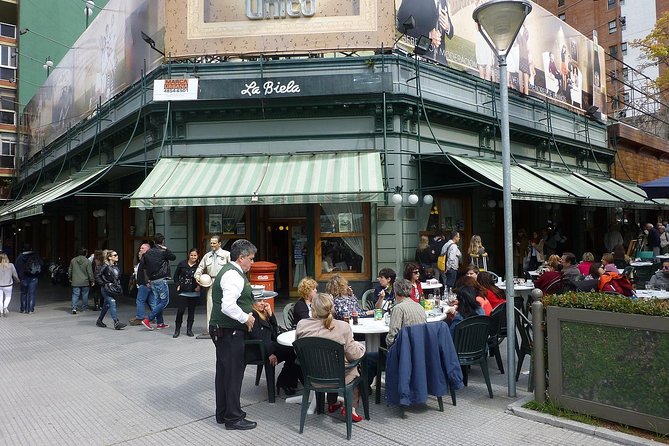
The meeting point is outside the main corner entrance of La Biela café at Avenida Presidente Manuel Quintana 596. Look for the huge gomero tree and the red pay phones. Your guide carries a small Walking Tours sign.
That tree is not just a meeting marker. It is the first lesson in how this tour works. The guide explains why the gomero is famous, then uses the café, the surrounding pavement, and the district itself to introduce Recoleta’s social character. I like this kind of beginning because you start with something you can see before moving into names and dates.
The tour runs in the afternoon and lasts about three hours, with roughly two miles of walking. The route is described as easygoing, but one detailed account warns that the guide may set a brisk pace. Wear comfortable shoes and do not plan a demanding activity immediately afterward.
The end point is Floralis Genérica on Avenida Presidente Figueroa Alcorta, listed as about half a mile from the starting point. The route itself includes many stops, so the walking distance and time matter more than the simple gap between the start and finish on a map.
More Private Tours in Buenos Aires
- Buenos Aires City Private Tour with Local Guide
★ 5.0 · 3,475 reviews - Private Airport Transfer In or Out : Ezeiza (EZE) – Buenos Aires
★ 5.0 · 548 reviews - Private Full-Day Iguazu Falls Tour with Airfare from Buenos Aires
★ 4.5 · 387 reviews
Recoleta Cemetery: tombs with city-sized stories
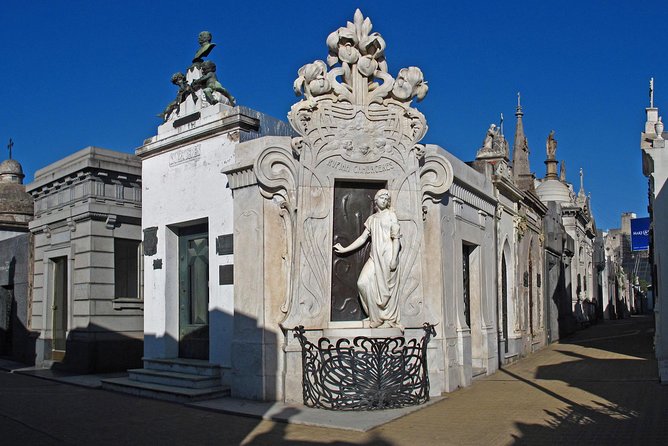
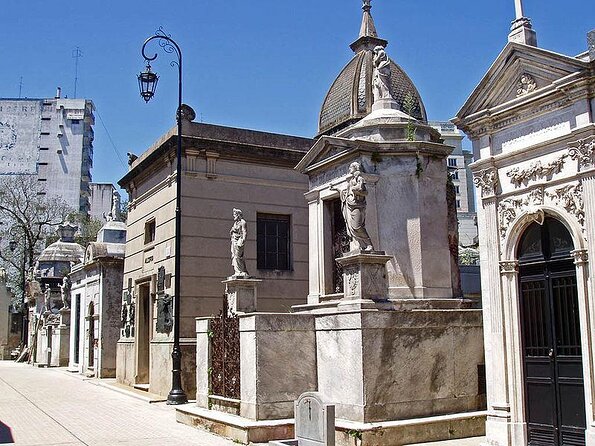
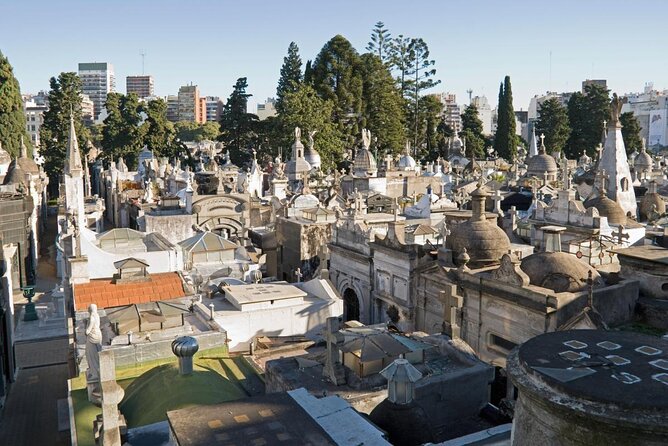
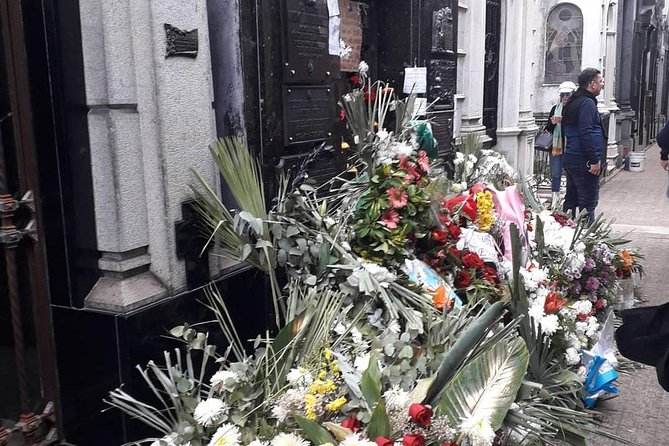
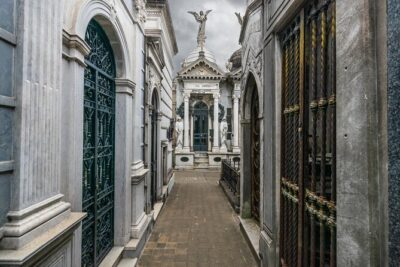
The cemetery is the heart of the experience. It is not a conventional park with rows of identical markers. The tombs are compact architectural statements, with family names, sculpture, ironwork, and narrow passages that can feel like streets in a small stone city.
A guide adds the part you cannot get from a map. You hear how the cemetery developed, who the Recoletos were, and why this former monastery area became one of Argentina’s most important burial grounds. The stories move beyond famous politicians and into family drama, social ambition, grief, and national identity.
Evita Perón is the unavoidable stop. Her tomb is modest compared with some of the grander structures nearby, which makes her story even more striking. The guide explains her life, her political era, her public role, and why she is buried in the Duarte family plot under the name of her family rather than in a monument built solely for her.
The route also includes Rufina Cambaceres and the misfortune associated with her burial, along with Tiburcia Dominguez and her famously miserly husband. Admiral Brown brings in Argentina’s naval past, while General Guido and other figures widen the story beyond the best-known names.
You may also hear about Liliana Crociatti, the very wealthy Leloir family, and other residents whose lives reveal the city’s old class structure. This is where a good guide matters. The cemetery can look like a collection of impressive façades, but the stories explain who had money, who had power, who was remembered, and who was nearly forgotten.
The cemetery visit is listed at about an hour and a half within the main itinerary, though some people have experienced a shorter overall tour. That difference is important. If your main goal is a long, detailed cemetery visit, confirm the expected timing with the operator before booking. One dissatisfied participant felt the cemetery portion alone was the main event and that a self-guided visit might have offered better value.
For most people, I think the guide earns the admission cost here, especially if you enjoy unusual human stories. The cemetery is open to independent visitors, but it is easy to walk past the most interesting tombs without knowing why they matter.
Pilar Basilica and the old monastery
Next comes the Basilica de Nuestra Señora del Pilar, a short walk from the cemetery. The church was built for the Recoletos, the religious order that gave the district its name. It dates to the colonial period, nearly half a century before the American Revolution.
The building offers a useful contrast with the cemetery. Inside, the focus shifts from elite families and national heroes to religious foundations and the city’s early Spanish influence. The guide explains who built the church, who used it, and how the old monastery relates to the cemetery and the neighborhood.
You should allow about 15 minutes here. It is not a full church tour with extended free time, but the stop gives the cemetery a clearer setting. You are not looking at an isolated monument. You are seeing the remains of a religious complex that helped shape Recoleta.
The nearby Recoleta Cultural Center and Old Monastery add another layer. The center occupies a former convent complex and helps show how the area changed from religious grounds into a cultural district. The tour may also include Bourdelle’s Monument to Alvear, a powerful sculpture honoring General Carlos María de Alvear.
Independence, monuments, and Argentina’s public memory
At the Monumento al General Carlos María de Alvear, the guide connects the sculpture to Argentina’s independence, neighboring countries, and the military and political figures who shaped the new nation. This is a short stop, but it keeps the tour from becoming only a cemetery walk.
That same idea continues at the Monumento de Francia a la Argentina. Sculpted by Emile Peynot and presented by France for Argentina’s centennial, the monument carries symbolic meaning that is easy to miss if you simply pass by. The guide explains how to read the figures and design rather than treating it as another photo stop.
The National Fine Arts Museum is also viewed from the outside. You learn how the classic-looking building became a museum and hear about some of its artworks. Admission is listed as free, but this experience does not appear to include a full museum visit. If you want to see the collection properly, plan a separate visit.
That distinction matters. The tour gives you a framework for the museum, the monuments, and the district. It does not replace time inside every cultural institution on the route.
More Walking Tours in Buenos Aires
- Buenos Aires Hop-On Hop-Off Bus, Free Walking Tours & Discounts
★ 4.5 · 2,218 reviews - Buenos Aires: La Boca Guided Walking Tour in English
★ 4.8 · 1,587 reviews - La Boca Walking Tour
★ 5.0 · 1,029 reviews - Recoleta Cemetery Walking Tour
★ 5.0 · 668 reviews
Palais de Glace and the story of tango
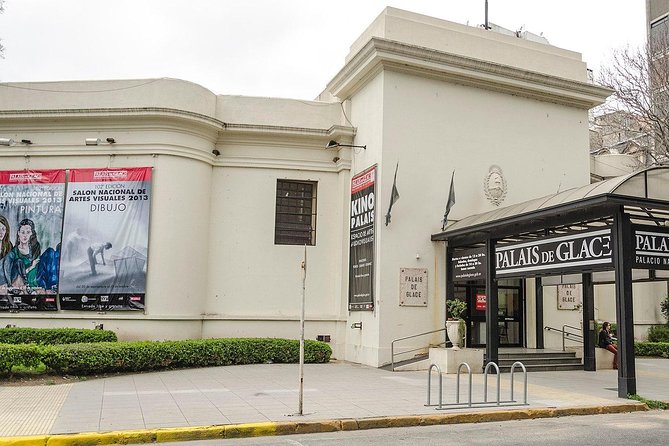
The Palais de Glace, or Ice Palace, is one of the route’s most entertaining stops. The building became associated with the early development of tango, and your guide explains how the dance came of age there.
Tango is often presented as a polished stage performance, but its story begins with movement between social groups, neighborhoods, ports, and immigrant communities. The guide places the dance within Buenos Aires life, including the influence of immigration and the city’s port culture.
I like this stop because it links art, music, class, and migration. You are not merely told that tango is Argentine. You get a sense of how a dance can carry the tensions and mixtures of a growing city.
The Palais de Glace stop itself may be brief, listed at about five minutes. The value comes from the explanation, not from a long interior visit. Depending on the day and current conditions, the group may continue through nearby terraces and the Buenos Aires Design Center.
Palermo Chico, the National Library, and Evita’s final days
After Recoleta, the walk moves toward Palermo Chico, a more polished residential area with grand buildings, embassies, monuments, and formal green spaces. The change in atmosphere helps show how Buenos Aires expanded beyond its older religious and civic centers.
The route includes the National Library, whose bold brutalist design contrasts sharply with the cemetery’s ornate tombs and the Basilica’s colonial style. The guide also explains the Eva Perón monument in this area and why the site matters: it is where Evita died.
Seeing both places connected to Evita gives her story a clearer shape. The cemetery shows where she was buried and how the public remembers her. The Palermo Chico monument marks the place of her death and opens a discussion about architecture, politics, and memory.
Nearby, the San Martín National Institute points to another chapter in the country’s past. The site recalls the home associated with José de San Martín, Argentina’s leading independence hero, who lived there from 1834 to 1848 after political intrigue forced him into exile in 1824. The house is described as a French provincial-style residence in an upscale neighborhood.
This part of the tour is especially useful if you want to understand how Buenos Aires uses monuments and buildings to tell national stories. The city does not put all its history behind museum doors. It places it in streets, façades, statues, and memorials.
Casa Alcorta and the world of Buenos Aires wealth
Casa Alcorta, now associated with the Renault Museum, offers one of the route’s more unusual architectural details. The Palacio Alcorta was built with a large race and test track on its roof, a remarkable feature for a city residence.
The building was later converted into a luxury housing complex in Palermo Chico. The stop is short, but it helps you notice the district’s mix of old wealth, automotive history, design, and changing real estate uses.
The Museo Nacional de Arte Decorativo provides a more extended look at aristocratic life. It occupies the 1917 Residencia Errázuriz Alvear, a Beaux-Arts mansion modeled in part on the Palace of Versailles. The collection includes furnishings, decorative objects, and belongings connected to the family who lived there.
The tour may explain the building and its owners, but the itinerary does not promise a full interior visit. If grand interiors interest you, save time to return on your own. Even from the outside, the residence helps explain the scale and taste of Argentina’s early 20th-century upper class.
MALBA, the Latin American Art Museum of Buenos Aires, is another important cultural marker along Figueroa Alcorta Avenue. Founded by Argentine businessman Eduardo Costantini, the museum focuses on Latin American art from the beginning of the 20th century to the present. As with the other museums, the walk provides context rather than a complete gallery visit.
Floralis Genérica: a fitting final stop
The walk concludes at Floralis Genérica, the giant metal flower on Avenida Presidente Figueroa Alcorta. The guide explains who donated it and why it was created.
It is a good ending because the flower gives you a simple visual symbol after several hours of churches, tombs, political figures, museums, and architectural detail. The sculpture is also close to major Palermo attractions, the National Fine Arts Museum, and the university area, so you can continue exploring after the guide leaves.
The flower may not be operating in its usual way on every visit, and the itinerary notes that the close-up visit is included when available. Treat it as a final landmark rather than the sole reason to book.
What $109 buys you
The price is $109 per person. It includes a professional English-speaking guide and admission to Recoleta Cemetery. Meals, hotel pickup, and hotel drop-off are not included.
For a private experience, the cost can be reasonable if you are traveling with family or friends and want the freedom to ask questions. The value rises when your guide is as strong as Carlos or Marciano, both praised for clear English, energy, storytelling, and strong command of Buenos Aires history.
The value drops if you mainly want to see Evita’s tomb and then leave. You can visit Recoleta Cemetery independently, so the fee is paying for interpretation, organization, and the wider route.
The overall rating is 4.5 from 87 ratings, with many high marks for the guides’ storytelling and the amount learned about Buenos Aires. A few lower ratings point to real concerns: one guide answered the phone several times and arrived eating, while another person felt information was being held back to promote a different tour. These are not reasons to reject the experience outright, but they show why guide quality matters greatly on a private walk.
Practical details before you book
The tour operates rain or shine. Weather, strikes, protests, repairs, city events, and timing can affect how much of the route is completed. The full list of stops is ambitious for three hours, especially when cemetery stories lead to questions.
Most people can participate, and the tour is near public transportation. Children age eight and under are free when accompanied by an adult. Because the walk covers about two miles and may move at a brisk pace, I would choose it for people who are comfortable walking for several hours.
You receive confirmation within 48 hours, subject to availability. The experience is usually booked about 18 days ahead, so reserve early if your schedule is tight. Free cancellation is available up to 24 hours before the local start time. Changes or cancellations inside that window are not refunded.
Should you book the Recoleta in Depth walk?
Book it if you want the cemetery to make sense, enjoy personal storytelling, and like connecting Buenos Aires architecture with immigration, tango, religion, politics, and wealth. It is also a good first-day activity because it gives you names and themes to recognize during the rest of your stay.
Think twice if you want long, unhurried museum visits, a slow photo walk, or only the cemetery. The route has many stops, and not every building includes interior admission. You should also ask about the planned balance between cemetery time and the wider Recoleta and Palermo route.
My advice is simple: choose this private tour for the guide, not just the sights. A good guide can turn Evita, Rufina Cambaceres, the Palais de Glace, and Floralis Genérica into a connected story of Buenos Aires. If your group values that kind of explanation, $109 can be fair. If you prefer exploring at your own pace, visit the cemetery independently and use the savings for a museum admission or a tango evening.
FAQ
How long does the Recoleta walking tour last?
The tour lasts approximately three hours and covers about two miles on foot.
Where does the tour begin?
It begins outside the main corner entrance of La Biela café at Avenida Presidente Manuel Quintana 596, near the red pay phones and the large gomero tree.
Where does the tour end?
The tour ends at Floralis Genérica on Avenida Presidente Figueroa Alcorta 2301, approximately half a mile from the starting point.
Is Recoleta Cemetery admission included?
Yes. Admission to Recoleta Cemetery is included in the tour price.
Are meals and hotel transportation included?
No. Meals, hotel pickup, and hotel drop-off are not included.
Can children join the tour?
Yes. Children age eight and under are free when accompanied by an adult.
Does the tour operate in bad weather?
Yes. The tour operates rain or shine, although weather and other city conditions may affect how much of the full itinerary is covered.
Recently added around Buenos Aires
- Photo Session in Buenos Aires★ 5.0 · 26 reviews
- Your Personal Photographer in Buenos Aires★ 5.0 · 24 reviews
- Discover Buenos Aires’ independent art scene — Ticket included★ 5.0 · 30 reviews
- Your Private Photographer in Buenos Aires★ 5.0 · 4 reviews
- Yerba Mate Workshop – Learn to Drink Mate like a Local!★ 5.0 · 11 reviews
- Taste of Tradition: Yerba Mate & Alfajores Experience★ 4.0 · 5 reviews
- Wine tasting in OASIS Palermo★ 5.0 · 2 reviews
- Day Tour Classic★ 3.5 · 35 reviews
Walking Tours, compared.
Buenos Aires Hop-On Hop-Off Bus, Free Walking Tours & Discounts
Read our review →
German Footprint & Nazi presence – Walking Tour in Bariloche
Read our review →
Full Day Buenos Aires Private Walking Tour – Your Own Personal BA 101
Read our review →
Discover Buenos Aires: Walking Tour Through San Telmo & Center!
Read our review →
Browse the lists this tour appears in