
Reviewed · WALKING TOURS
Best of Buenos Aires Private Walking Tour
Buenos Aires rewards curious walkers. This private tour connects Florida Street, Plaza San Martín, Recoleta, and Avenida Alvear through stories about architecture, politics, immigration, money, and war. I like the wide range of sights and the way the guide links grand buildings to the people who built them. I also like the small, surprising details, from a former cattle auction house to a church built by one of Argentina’s wealthiest women.
The main thing to consider is the pace. You cover a lot of ground in roughly 2.5 to 3 hours, with plenty of standing and walking. One past guest found the route demanding and wished for easier transport back to the hotel, while most praised guides such as Martin, Carlos, and Mariano for making the walk relaxed, funny, and easy to follow.
In This Review
- Key points to know before booking
- A morning that explains Buenos Aires through its buildings
- Florida Street begins the story downtown
- Churches, towers, and the power behind the palaces
- Plaza San Martín and Buenos Aires’ aristocratic ambition
- Difficult subjects along Plaza de la Embajada de Israel
- Patio Bullrich reveals British business influence
- From the Vatican’s local address to Avenida Alvear
- Recoleta Cemetery deserves the full hour
- Finishing at La Biela gives you a useful next move
- How the guides shape the experience
- Is $109 per person fair value?
- Who should book this private walk?
- FAQ
- How long does the Buenos Aires walking tour last?
- What time does the tour start?
- Where does the tour end?
- Is this a private tour?
- What is included in the price?
- Is hotel pickup included?
- Are meals included?
- Is Recoleta Cemetery included?
- Can children join the tour?
- Does the tour operate in bad weather?
- Is the tour suitable for people who cannot walk far?
- Can I cancel for a refund?
- Should you book it?
Key points to know before booking
- At least 25 major sights fit into one morning, making this a useful first look at central Buenos Aires and Recoleta.
- The route crosses several neighborhoods, from downtown’s Florida Street to the polished streets around Recoleta Cemetery.
- The private format gives your group the guide’s full attention, though the quality of the experience depends greatly on the guide assigned.
- Architecture is the main attraction, with Art Deco, French-inspired palaces, colonial churches, British monuments, and former aristocratic homes.
- La Recoleta Cemetery receives the longest visit, including Evita Perón’s family mausoleum and stories about other notable burials.
- The $109 price is easiest to justify for a small group, especially if you value a private guide and detailed historical explanation.
A morning that explains Buenos Aires through its buildings
This is not simply a march from one photo stop to another. The route uses buildings and monuments to explain how Buenos Aires became a city shaped by Spanish roots, European immigration, British business, immense private fortunes, military conflict, and social ambition.
You meet outside Florida Garden at Florida 899, near the corner with Paraguay Street. Look for a guide holding or wearing a small BA Walking Tours sign. The start is no later than 10 a.m., so arrive early. The meeting point is central and near public transportation, but hotel pickup is not included.
The tour is private, meaning only your group takes part. That matters here because the itinerary is packed. A private guide can answer questions about a particular palace, slow down for photographs, or explain a political subject in more detail. It also means you are not waiting for a large group to gather at every crossing.
The official duration is about three hours, while the description also refers to a 2.5-hour walk. The listed stops add up to a longer morning if every explanation receives its full time. In practice, you should plan for a solid half-day window rather than scheduling a tight lunch or museum appointment immediately afterward.
More Private Tours in Buenos Aires
- Buenos Aires City Private Tour with Local Guide
★ 5.0 · 3,475 reviews - Private Airport Transfer In or Out : Ezeiza (EZE) – Buenos Aires
★ 5.0 · 548 reviews - Private Full-Day Iguazu Falls Tour with Airfare from Buenos Aires
★ 4.5 · 387 reviews
Florida Street begins the story downtown
The first real stop is Calle Florida, one of Buenos Aires’ oldest commercial streets. It links the area around Plaza de Mayo with Plaza San Martín, and the guide uses it to introduce the city’s early development and its changing role as a shopping street.
Florida Street is not the quietest part of the route. It is a busy commercial corridor, and you will spend only a few minutes here before moving on. Still, it is a useful opening because it places you in the city center and shows how old civic spaces and modern commerce sit side by side.
From there, the walk turns toward grand institutions and private residences. You begin to see why Buenos Aires earned its Paris comparison, although the guide also makes clear that the city’s identity is not simply European imitation.
Churches, towers, and the power behind the palaces
The Basilica del Santísimo Sacramento is an early example of the tour’s approach. Built in 1916 by Mercedes Anchorena for her family, it is not presented as just another church. The guide connects it to family rivalry, influence, money, and religious devotion.
The nearby Edificio Kavanagh provides one of the route’s strongest architectural moments. This Art Deco skyscraper overlooks Plaza San Martín and was once the tallest skyscraper in Latin America. Corina Kavanagh, a millionaire of Irish descent, sold two ranches at age 39 to finance the building, which was completed in only 14 months in 1934.
That story gives the façade a human edge. You are not merely looking at a tall tower. You are hearing about a woman who used her fortune to make a highly personal mark on the city. The building is also described as a UNESCO heritage building, adding to its importance for architecture fans.
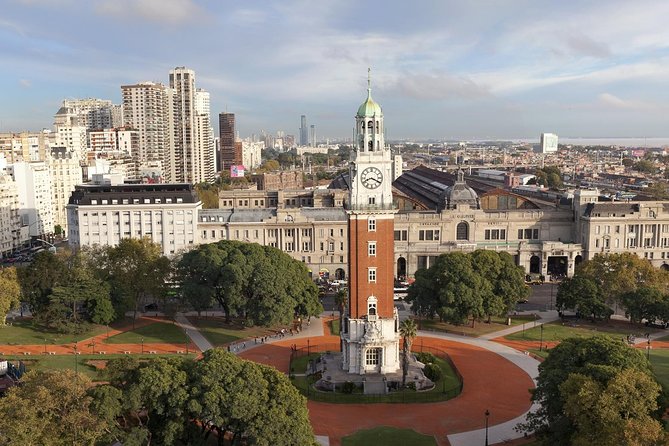
At the Torre Monumental, formerly known as the British Clock Tower, the subject shifts from style to foreign influence. The guide explains the strong British role in Argentina’s economy and considers why British institutions, businesses, and symbols became so important here.
Across from the tower, the Monumento a Combatientes de Malvinas commemorates the 1982 South Atlantic conflict, known in Argentina as the Malvinas War and in Britain as the Falklands War. This pairing is one of the more useful parts of the tour. It places a British symbol beside a memorial to a painful conflict and opens a discussion about Argentina’s long, complicated relationship with England.
Plaza San Martín and Buenos Aires’ aristocratic ambition
Plaza General San Martín adds another layer. The park occupies land connected to old military and colonial activity, including a fort and a bullfighting ring. Its centerpiece honors General José de San Martín, Argentina’s leading independence hero.
The guide explains San Martín’s role in the country’s independence movement, giving the monument more meaning than it would have on a quick solo walk. This is a recurring strength of the experience: grand public spaces become easier to understand when someone explains what happened there and why the monument matters.
Next comes Palacio Paz, a vast city palace built in 1914 for José C. Paz, newspaper owner and aspiring president. Its materials were imported from France, and the property contains 120 rooms, an astonishing scale for a family home.
Palacio San Martín, originally the Anchorena family palace, continues the theme of elite wealth. Its current name reflects later political use, while the guide focuses on Mercedes Anchorena and her connection to the neighboring Basilica del Santísimo Sacramento.
Palacio Estrugamou then introduces the Barrio Norte area, filled with Parisian-style buildings and elegant streets. Here, the guide broadens the story to include Spanish, Italian, French, and British immigration. The point is not only that Buenos Aires looks European. It is that immigrants, local fortunes, business interests, and political power all helped shape the city’s appearance.
More Walking Tours in Buenos Aires
- Buenos Aires Hop-On Hop-Off Bus, Free Walking Tours & Discounts
★ 4.5 · 2,218 reviews - Buenos Aires: La Boca Guided Walking Tour in English
★ 4.8 · 1,587 reviews - La Boca Walking Tour
★ 5.0 · 1,029 reviews - Recoleta Cemetery Walking Tour
★ 5.0 · 668 reviews
Difficult subjects along Plaza de la Embajada de Israel
The stop at Plaza de la Embajada de Israel is brief but serious. In 1992, a bombing destroyed the Israeli Embassy and killed 24 people. The guide discusses what happened, the political background, and questions of justice in Argentina.
This is not a light sightseeing stop, and some people may find the subject heavy in the middle of an architecture walk. I consider it worthwhile because it shows that Buenos Aires cannot be understood only through elegant façades and wealthy families. The city’s modern political story is part of its public spaces too.
The former Ortiz-Basualdo Palace, now the French Embassy, brings the tone back to architecture and social history. The guide shares stories connected to the building, including a visit by Edward VII of England with his future American wife. These bits of courtly gossip may sound minor, but they help you picture how Buenos Aires’ upper class connected itself to European royalty and fashion.
Patio Bullrich reveals British business influence
Patio Bullrich is one of the route’s most unusual stops. Today it is an upscale shopping center, but the building began life in 1867 as a British-influenced auction house for the Bullrich family.
Its original business involved livestock, prize bulls, thoroughbreds, heirlooms, and other valuable goods. That history helps explain how British commercial practices reached far beyond railways or diplomatic buildings. The guide also points out its connection to English Argentine architect Juan Waldorp.
You spend about 15 minutes here, longer than at most buildings. That makes sense, since the site neatly links architecture, commerce, cattle, wealth, and modern retail. If you like seeing how old buildings are reused, this is one of the most satisfying stops.
From the Vatican’s local address to Avenida Alvear
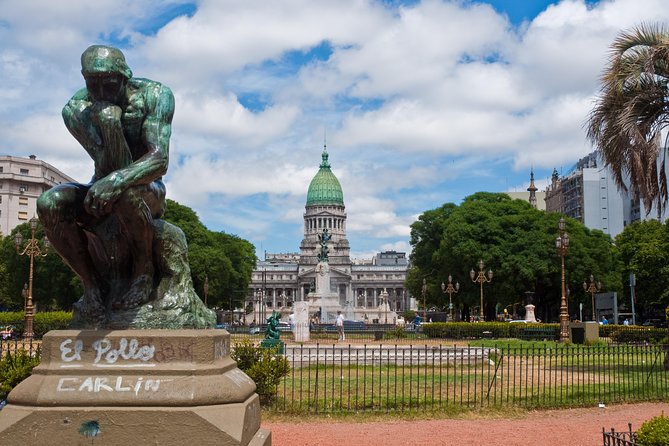
The Apostolic Nunciature, associated with the Holy See, brings religion and private wealth back into the story. The guide discusses why Argentina has produced a pope and how wealthy Argentine women, including members of the Anchorena and Harilaos families, supported the church.
Adelia Harilaos donated her palace to the Vatican, a detail that gives the building a strong personal connection. You also hear about the relationship between Argentina’s richest families and religious institutions, a useful counterpoint to the tour’s earlier discussion of business and politics.
The walk then reaches Recoleta and Avenida Alvear. Recoleta began with land given to Franciscan Recoletos monks. Today, it is an affluent district of former palaces, Paris-style townhouses, boutiques, galleries, and polished avenues.
Avenida Alvear is one of Buenos Aires’ most elegant streets. The guide explains the large homes and the social class that built them, while also covering immigration between 1880 and 1930 and Argentina’s rise and decline as a wealthy nation.
This part is especially valuable if you want context rather than isolated facts. The mansions are impressive, but the guide asks you to consider how national prosperity, agricultural exports, European immigration, and elite spending produced such a grand district.
Recoleta Cemetery deserves the full hour
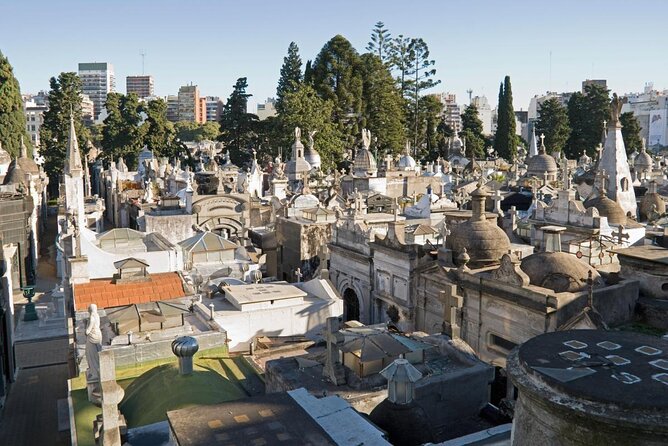
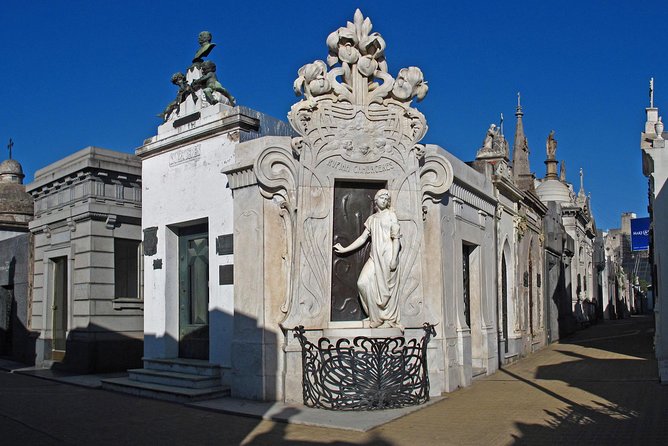
The longest stop is La Recoleta Cemetery, where the tour can spend about an hour. Admission is included, so you do not need to buy a separate ticket.
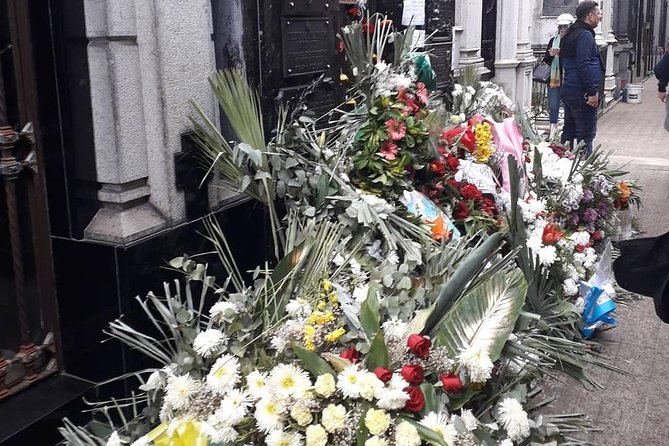
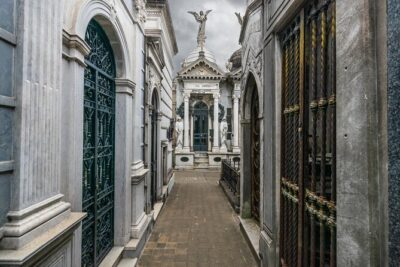
The cemetery is famous for its ornate mausoleums and for the grave of Eva Perón, but the guide does not stop with Evita. You hear her story, see her memorial, and learn how her burial place fits into Argentina’s political and social divisions.
Other stories include the misfortune of Rufina Cambaceres, the miserly husband of Tiburcia Domínguez, Admiral Brown, the wealthy Leloir family, General Guido, and Liliana Crociatti. These personal stories give the cemetery its appeal. You are not only looking at stone monuments. You are hearing about ambition, family conflict, tragedy, public fame, and private fortune.
The cemetery portion also connects to nearby cultural sights and public art. The broader explanation can include the Pilar Basilica, the former monastery and cultural center, Bourdelle’s monument to Alvear, Palais de Glace and the development of tango, the history of the port and immigration, the Buenos Aires Design Center, the Giant Flower when available, Palermo Chico, the National Library, Loma Mitre, the Monument to France and Argentina, and the National Fine Arts Museum.
Because the route is long and city conditions can change, the complete list may not receive equal attention. Weather, strikes, repairs, demonstrations, and timing can affect coverage. If the cemetery is your top priority, say so at the start and keep an eye on the clock.
Finishing at La Biela gives you a useful next move
The walk ends outside La Biela, a famous café on Avenida Presidente Manuel Quintana. The guide explains the café, Recoleta, and nearby sights, then leaves you in one of Buenos Aires’ main restaurant and attraction districts.
This is a practical ending. You can stop for coffee, eat nearby, continue to the cemetery if it received less time than expected, or explore Recoleta on your own. The downside is that there is no hotel drop-off. One past guest found the walk back to the hotel added another hour, so check your return route before setting out.
You should also wear comfortable shoes and bring water. The route is described as manageable for people who can keep up, but it is still continuous walking through several districts. The tour operates rain or shine, so a wet morning can make the experience less comfortable, even though one past guest found the tour enjoyable in the rain.
How the guides shape the experience
The strongest praise focuses on the guides’ command of English, humor, local knowledge, and ability to connect architecture with Argentine society. Martin is repeatedly singled out as funny, clear, and strong on social, economic, and political background. Carlos is described as experienced and entertaining, while Mariano is praised for showing guests places they might not find alone.
That does not mean every guide will use the same style. One past guest felt the guide spent too much time promoting other tours and was not responsive enough to questions. If you want a discussion-heavy walk, ask questions early and clearly. If a particular guide is available, you can ask for Martin, Carlos, or Mariano, but an individual guide cannot be guaranteed from the information provided.
The private format helps. You can tell the guide if you prefer architecture, Argentine politics, Evita, immigration, or unusual personal stories. The tour works best when you treat it as a conversation rather than a fixed lecture.
Is $109 per person fair value?
At $109 per person, this is not the cheapest way to see Buenos Aires. The price includes a private English-speaking guide and admission to Recoleta Cemetery, but not meals, hotel transfers, or other entrance fees.
I think the value depends on group size. For two people, the cost is substantial for a morning walk. For a family or small group dividing the private rate, the personal attention becomes more attractive. You are paying for the guide’s interpretation, not for transport or a long list of paid attractions.
The tour also covers a great deal in a short time. If you tried to understand Florida Street, Plaza San Martín, the palaces, Recoleta, and the cemetery alone, you could easily spend several days reading plaques and arranging your route. The guide saves time and adds context, especially around subjects such as British influence, the Malvinas War, elite families, and Argentina’s changing fortunes.
The 4.6 rating from 73 published ratings and the 92 percent recommendation rate suggest a strong record, with the usual warning that guide style and walking ability matter. I would choose it for a first full day or second morning in Buenos Aires, when you want a map of the city’s history before exploring selected areas on your own.
Who should book this private walk?
I would recommend it to first-time visitors who want a fast but serious introduction to Buenos Aires. It suits people who care about architecture, history, political stories, immigration, and the personal dramas behind famous monuments.
It also works well for returning visitors who have already seen the main squares but want the background behind Barrio Norte and Recoleta. The cemetery section alone offers more than a quick visit focused only on Evita.
I would hesitate if you dislike long walks, prefer a slow photography tour, or need guaranteed access to every listed stop. The route is dense, and the full itinerary depends on weather and city conditions. You should also allow extra time afterward for your return journey.
FAQ
How long does the Buenos Aires walking tour last?
The experience is listed as approximately three hours, while the description also refers to a 2.5-hour walk. Plan for a solid morning because the route includes many stops and continuous walking.
What time does the tour start?
The meeting time is no later than 10 a.m. You meet outside the corner door of Florida Garden at Florida 899, near Paraguay Street.
Where does the tour end?
The walk ends outside La Biela café at Avenida Presidente Manuel Quintana 596 in Recoleta.
Is this a private tour?
Yes. Only your group participates in the activity.
What is included in the price?
The price includes a professional English-speaking guide and admission to Recoleta Cemetery.
Is hotel pickup included?
No. Hotel pickup and drop-off are not included.
Are meals included?
No. Meals are not included in the tour price.
Is Recoleta Cemetery included?
Yes. Cemetery admission is included, and the route allows about one hour for a detailed visit.
Can children join the tour?
Children aged eight and under are free when accompanied by an adult.
Does the tour operate in bad weather?
Yes. The tour operates rain or shine. Weather and other city conditions can affect how much of the full route is covered.
Is the tour suitable for people who cannot walk far?
The tour is designed as a continuous city walk across several districts. Most participants can take part, but you should be comfortable walking for roughly 2.5 to 3 hours and keeping up with the group.
Can I cancel for a refund?
You can cancel at least 24 hours before the local start time for a full refund. Cancellations or changes made less than 24 hours before the start are not accepted for a refund.
Should you book it?
Book this tour if you want a private, story-led introduction to Buenos Aires and are happy to cover a lot of ground on foot. The route gives you grand architecture, difficult political history, aristocratic family stories, British connections, and a serious look at Recoleta Cemetery in one morning.
Skip it if you want a slow stroll, hotel transportation, or a short list of only the most famous sights. For the right group, especially one sharing the private price, it is a strong way to get your bearings and discover which parts of Buenos Aires deserve a longer return visit.
Recently added around Buenos Aires
- Photo Session in Buenos Aires★ 5.0 · 26 reviews
- Your Personal Photographer in Buenos Aires★ 5.0 · 24 reviews
- Discover Buenos Aires’ independent art scene — Ticket included★ 5.0 · 30 reviews
- Your Private Photographer in Buenos Aires★ 5.0 · 4 reviews
- Yerba Mate Workshop – Learn to Drink Mate like a Local!★ 5.0 · 11 reviews
- Taste of Tradition: Yerba Mate & Alfajores Experience★ 4.0 · 5 reviews
- Wine tasting in OASIS Palermo★ 5.0 · 2 reviews
- Day Tour Classic★ 3.5 · 35 reviews
Walking Tours, compared.
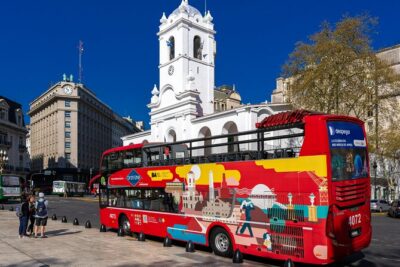
Buenos Aires Hop-On Hop-Off Bus, Free Walking Tours & Discounts
Read our review →
German Footprint & Nazi presence – Walking Tour in Bariloche
Read our review →
Full Day Buenos Aires Private Walking Tour – Your Own Personal BA 101
Read our review →
Discover Buenos Aires: Walking Tour Through San Telmo & Center!
Read our review →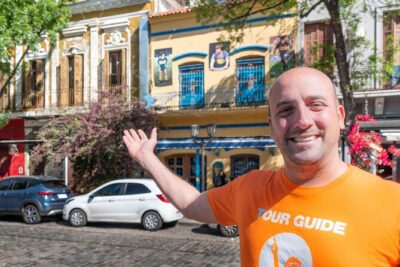
Browse the lists this tour appears in