
Reviewed · HISTORICAL TOURS
Recoleta Cemetery – Small Group Tour of History & Secrets
The dead have excellent architecture here. Recoleta Cemetery turns a visit to Buenos Aires into a walk through Argentina’s politics, art, religion, family drama, and social history. Instead of wandering among impressive but confusing mausoleums, you follow a guide who explains the people behind the marble.
I especially like the small group size, capped at 15 people, and the way the tour connects cemetery stories with the wider story of Buenos Aires. The guide also pays attention to comfort, looking for shady places and adapting when rain arrives. The main drawback is simple: the cemetery entrance fee of 22,600 Argentine pesos is extra, so the advertised price is not the full cost.
At $49 per person for 150 minutes, this is not the cheapest Buenos Aires walking tour. Still, the price makes sense if you want more than a quick look at Evita’s tomb. The guide’s storytelling, strong English, and careful attention to sculptures give the cemetery a human shape instead of leaving you with a map and a maze of grand facades.
In This Review
- Key points to know before you book
- Why Recoleta Cemetery deserves two and a half hours
- Meeting at La Biela and starting outside the gates
- Inside the cemetery: marble, power, and family pride
- The stories that give the tombs a human face
- Evita Perón’s mausoleum and the crowd magnet
- A guide who knows when to pause
- Heat, rain, and the practical side of the walk
- Is $49 a fair price?
- Who will enjoy this cemetery tour most?
- Should you book the Recoleta Cemetery Secrets tour?
- FAQ
- How long does the Recoleta Cemetery tour last?
- What is included in the tour price?
- Is the cemetery entrance fee included?
- Where is the meeting point?
- How will I recognize the guide?
- What language is the tour in?
- How large is the group?
- Is the tour wheelchair accessible?
- Can I cancel or pay later?
Key points to know before you book
- Evita’s mausoleum is only one part of the story: You will see the famous Duarte family tomb, but the tour also introduces political leaders, wealthy families, artists, and cemetery legends.
- The group never exceeds 15 people: Smaller groups make it easier to hear the guide, ask questions, and examine details on the mausoleums.
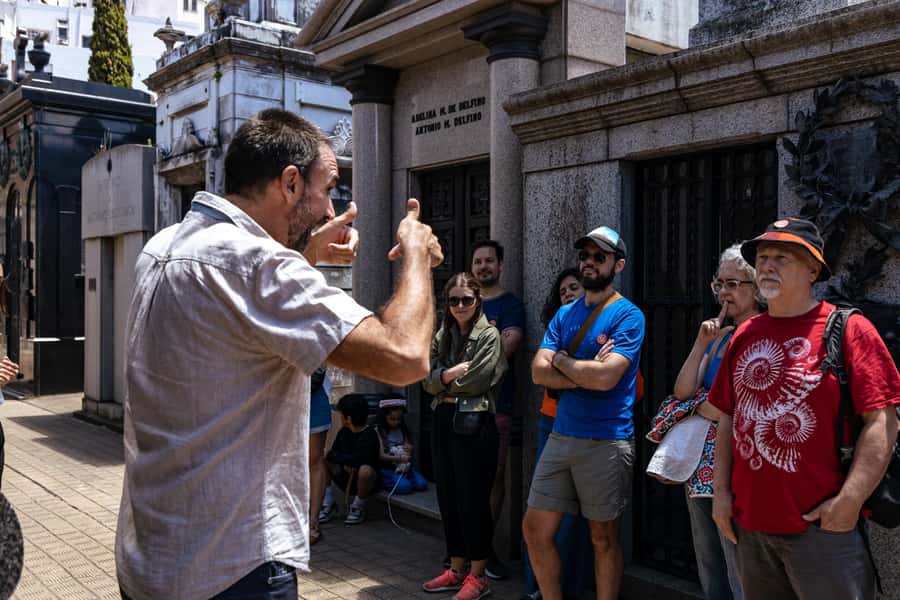
- Esteban is the guide most often associated with the experience: He is praised for clear English, humor, strong projection, and storytelling that links the cemetery to Argentina.
- The tour lasts 2.5 hours: That gives you time to understand the site, but you should expect continuous walking and limited sitting.
- You meet outside the cemetery: The meeting point is at Plazoleta Chabuca Granda, near La Biela in Recoleta. Look for the guide wearing a blue cap.
- The cemetery fee is separate: Plan for the additional 22,600 Argentine peso entrance charge before the tour begins.
Why Recoleta Cemetery deserves two and a half hours
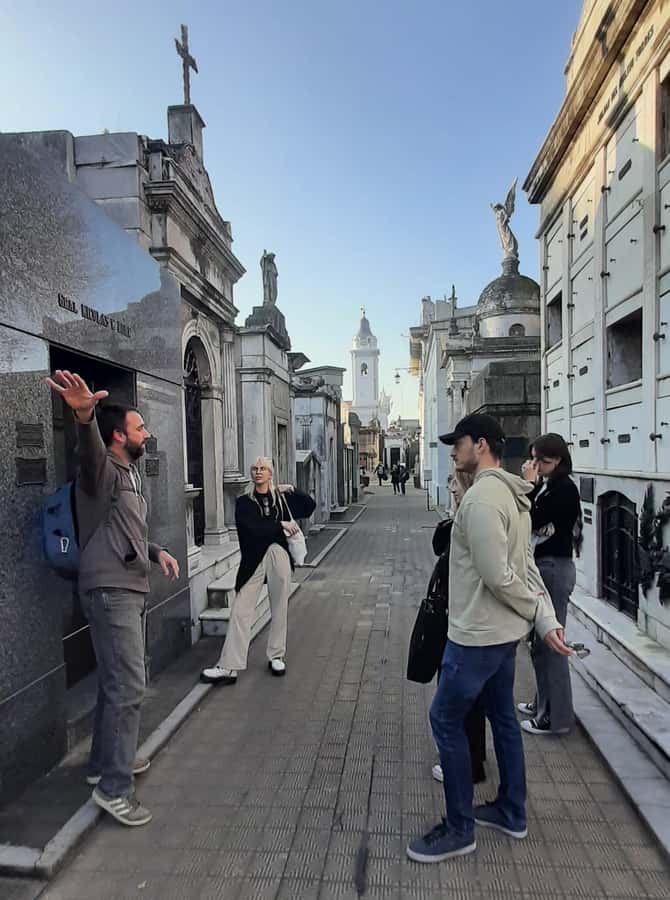
Recoleta Cemetery is not a normal cemetery visit. Its narrow paths are lined with family mausoleums designed like miniature city buildings, chapels, temples, and private palaces. Many were commissioned by Argentina’s most powerful families during the period when Buenos Aires was growing wealthy and looking toward Europe for style and status.
That setting gives the tour two subjects at once. You learn about the people buried here, but you also see how families wanted to present themselves after death. Marble, bronze, imported materials, carved angels, dramatic doors, and carefully planned facades all tell you something about class and ambition.
I like the 150-minute length because the site needs explanation. A short stop can show you beautiful stonework, but it cannot explain why certain families mattered, how Argentine society changed, or why one tomb attracts enormous attention. The time also allows the guide to pause for questions instead of racing from one famous grave to the next.
The pace appears suited to curious visitors rather than people seeking a quick photo stop. You should wear comfortable shoes, since this is a walking tour through the cemetery and not a seated lecture. If you have mobility concerns, the activity is listed as wheelchair accessible, though you may still want to confirm the exact route and conditions before booking.
More History Tours in Buenos Aires
- Historical Sherpa Food Tour of San Telmo with Street Food, Drinks
★ 5.0 · 920 reviews - Nazis in Buenos Aires: a historical walking tour
★ 4.9 · 193 reviews - San Telmo: Historical Guided Tour with Street Food & Drinks
★ 5.0 · 87 reviews
Meeting at La Biela and starting outside the gates
The meeting point is outside the cemetery at Plazoleta Chabuca Granda. If you are arriving by Uber or taxi, giving the driver the destination La Biela, at Avenida Presidente Manuel Quintana 596, should make the location easier to find.
The blue cap is a useful detail. Recoleta is a busy part of Buenos Aires, and a visible marker saves you from scanning every passerby for a guide holding a sign. The guide also sends meeting information through WhatsApp before the tour, including directions and how to recognize him.
You should arrive ready to pay the cemetery admission separately. The tour price covers the guided experience, but not the 22,600 Argentine peso entrance fee. Since prices in Argentina can change, check the current amount when you book and carry a payment method that works for the cemetery on the day.
Starting outside the gates also gives the group a clean introduction to the area. You are not thrown immediately into a maze of tombs. The guide can establish the setting first, then lead you inside with a sense of what to look for.
Inside the cemetery: marble, power, and family pride
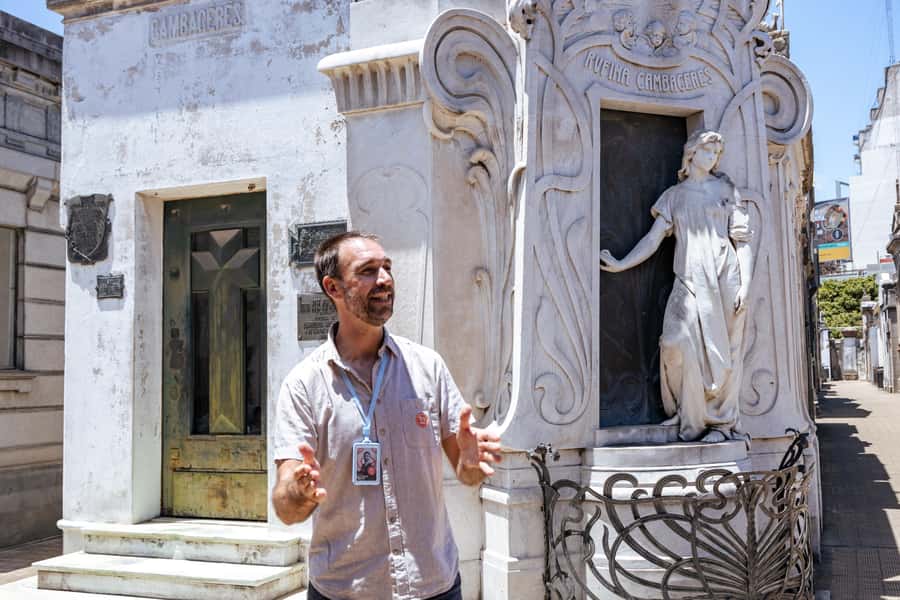
Once inside, the tour focuses on the cemetery’s mausoleums and the stories attached to them. The architecture is a major attraction, especially the work shaped by European artistic traditions and materials imported from Europe.
You will see buildings made to impress. Some families used sculpture to show wealth, faith, grief, military service, or public importance. Others left behind more intimate clues in the design. A cracked door, a carved figure, an inscription, or a family grouping can become part of a larger story when the guide explains it.
This is where a guide adds real value. The cemetery map offers little interpretation, so you can easily walk past an important tomb without knowing why it matters. A good guide points out details you might otherwise miss and explains how art and biography fit together.
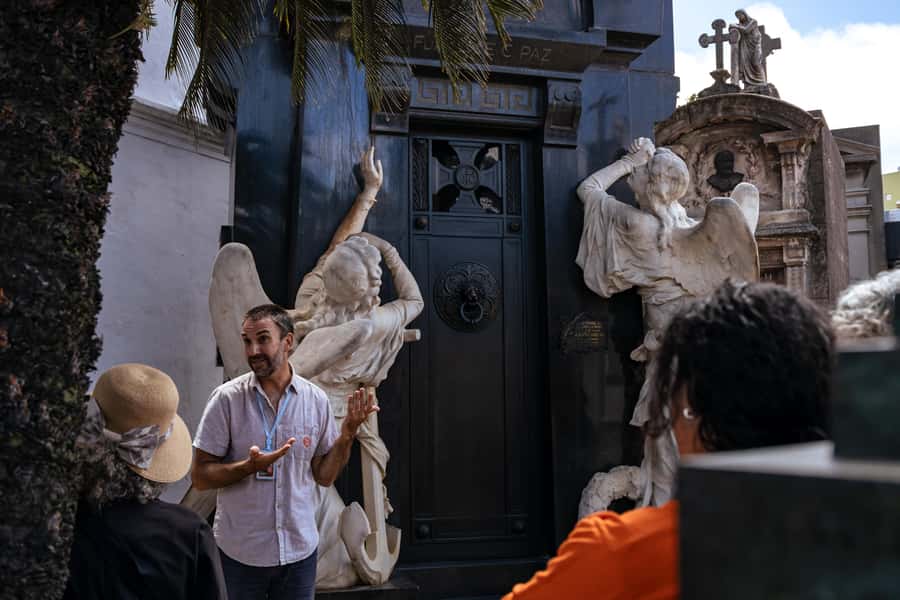
Esteban receives especially strong praise for noticing architectural features and bringing the people behind them to life. His approach is not limited to dates and names. He uses stories, cultural references, and humor, while still treating the cemetery as an active place of burial.
That balance matters. Recoleta is visually dramatic, but it is also a working cemetery. You are expected to behave respectfully, keep your voice appropriate, and take photographs discreetly. The mood can shift from grand and theatrical to personal and sad within a few steps.
The stories that give the tombs a human face
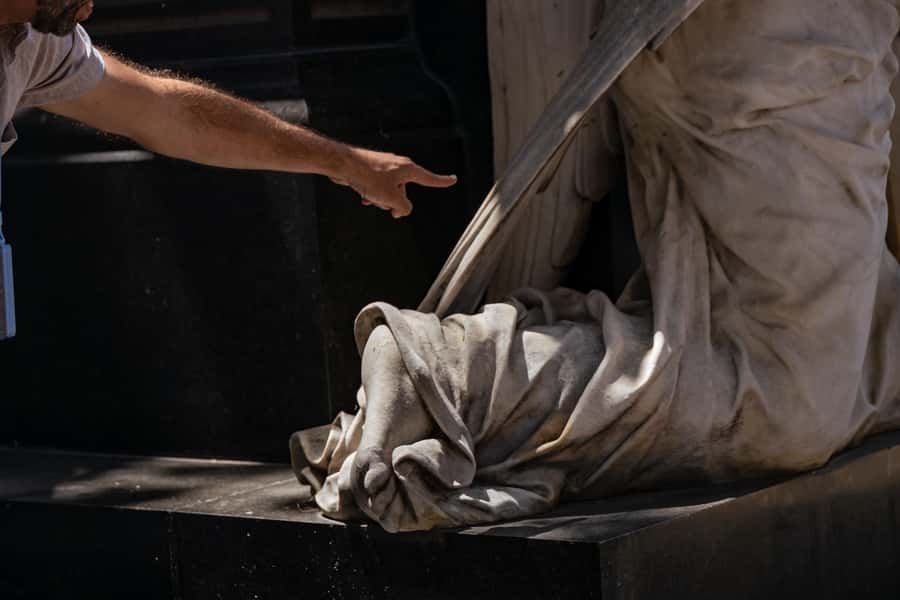
The advertised stories include a couple whose bitterness was carved into stone, a woman connected to the unsettling legend of being buried alive, and the political drama surrounding Evita Perón. These are exactly the kind of tales that make the cemetery memorable, but they work best when presented with care.
The story of the bitter couple shows how family conflict can become part of a public monument. Instead of viewing every tomb as a polished object, you begin to notice the emotions and messages built into the stone.
The legend of the woman buried alive adds a darker note. It is the sort of tale that can easily become cheap ghost-story entertainment, so the guide’s tone matters. The experience is promoted for history lovers, curious minds, and families, which suggests the stories are presented as part of the cemetery’s folklore and social memory rather than as a horror attraction.
You will also hear about notable figures whose lives reflect Argentina’s political and cultural changes. The tour uses the cemetery to explain Buenos Aires, so you get more than isolated biographies. The stories help you understand how status, religion, family, and national identity shaped the city.
This broader context is one of the strongest reasons to choose a guided visit. You may forget a date, but you are more likely to remember a family feud, an unsettling legend, or a striking sculpture that suddenly made sense.
More history-led tours in Buenos Aires:
- Buenos Aires: La Boca Art and History Walking Tour
★ 4.8 · 55 reviews - Buenos Aires: Historic Buenos Aires Landmarks & Icons Tour
★ 4.9 · 37 reviews - Private Evita and Peronism Historical Tour in Buenos Aires
★ 5.0 · 33 reviews - Buenos Aires: San Telmo, History, Bars, and Tango!
★ 5.0 · 24 reviews
Evita Perón’s mausoleum and the crowd magnet
Evita Perón’s final resting place is the cemetery’s best-known stop. Her mausoleum is among the most visited tombs in Recoleta, and it attracts people who may know little about the rest of the site.
The tour treats Evita’s tomb as part of a larger story rather than the whole purpose of the visit. That is the right approach. You will see the Duarte family mausoleum, but the surrounding cemetery helps explain why Evita remains such a powerful figure in Argentina and beyond.
Expect this stop to receive extra attention. It is the place most people recognize, and it may be the point where the group encounters the greatest interest from other visitors. The small-group format helps because you can hear the explanation and ask questions without being lost in a large crowd.
If Evita is your main reason for coming, this tour gives you useful context. If you are primarily interested in sculpture, architecture, or social history, you will probably find the many less famous tombs just as rewarding. The tour’s strength is its range.
A guide who knows when to pause
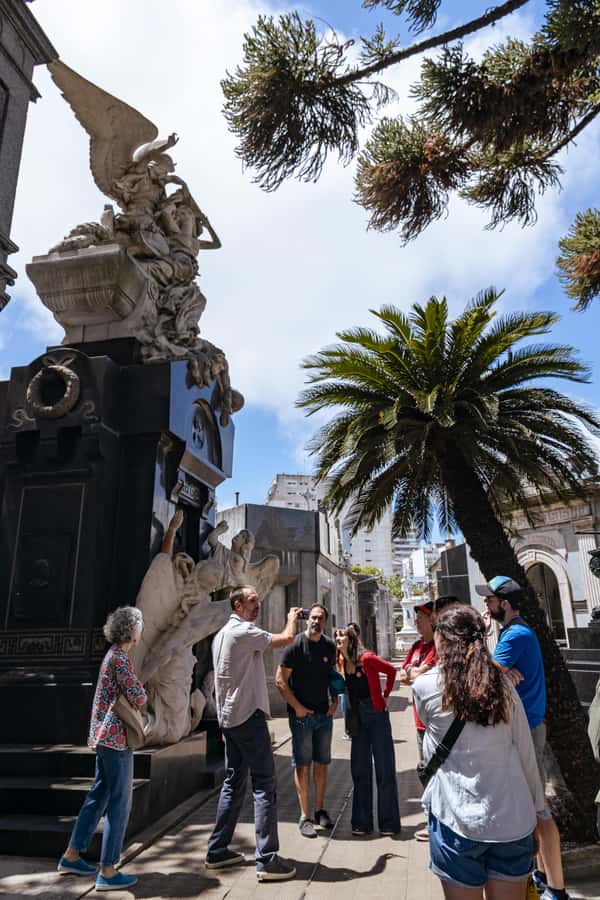
The strongest guide feedback centers on Esteban. He is described as funny, enthusiastic, clear in English, and able to project his voice well. That last point matters in a cemetery, where narrow paths, stone walls, and nearby groups can make a soft-spoken guide hard to follow.
He also encourages questions. That makes the experience feel less like a memorized speech and more like a conversation. You can ask about a name, an architectural feature, a political figure, or a custom that catches your attention.
Several comments point to his care with weather and comfort. He looks for shade during hot periods, and he has provided umbrellas when rain arrived. One small group also appreciated that the guide learned their names and backgrounds, then adjusted parts of the presentation to suit them.
That personal touch is useful, but you should keep expectations realistic. The group can be as large as 15, even though some departures may be much smaller. A group of four or six allows more conversation; a full group will feel less private, though still far more manageable than a large coach tour.
Guide names associated with the experience include Esteban, Ivana, and Sebastian. Esteban is the provider named for the activity and the guide most frequently praised in the available feedback. If having a particular guide matters to you, ask before booking rather than assuming.
Heat, rain, and the practical side of the walk
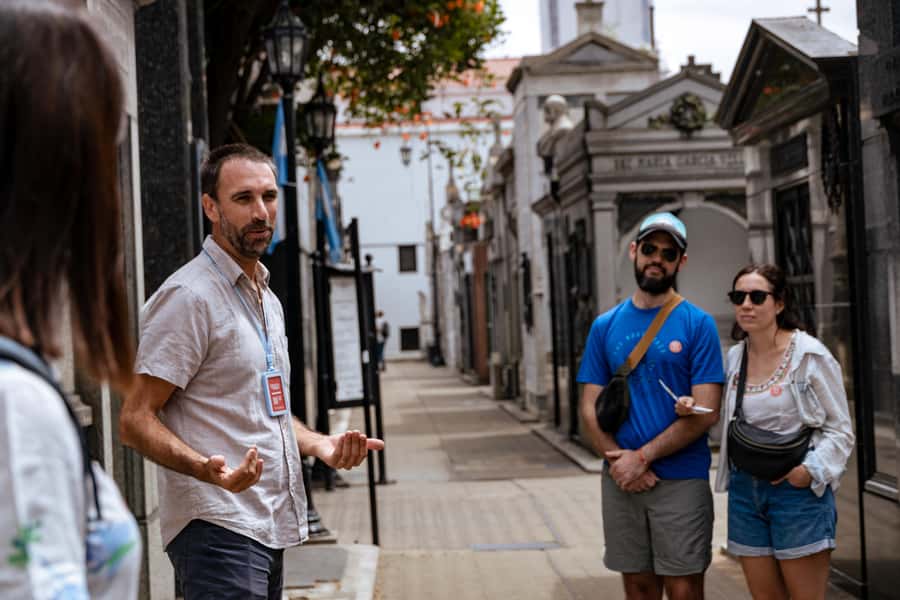
Buenos Aires weather can affect your enjoyment. The cemetery has exposed paths, stone surfaces, and limited shade in some areas. Comfortable shoes are essential, and a hat, water, and sun protection would be sensible additions even though only comfortable footwear is specifically required.
The guide’s habit of finding shady spots is a real advantage on a hot day. It also shows why a small group helps: the guide can respond to the conditions instead of moving a large crowd on a fixed route.
Rain does not necessarily end the experience. The guide has been praised for helping groups through sudden storms and, on one occasion, providing umbrellas. Still, you should dress for the forecast and remember that the tour remains outdoors.
Photography is allowed, but discretion is important. The cemetery’s sculptures are tempting subjects, yet this is not simply an open-air museum. Avoid treating funerary spaces like a photo set, and follow any instructions from cemetery staff or your guide.
The activity is listed as wheelchair accessible. Because the details of surfaces and the exact route are not provided, contact the operator if you need specific information about access. The same advice applies if you need frequent rest stops.
Is $49 a fair price?
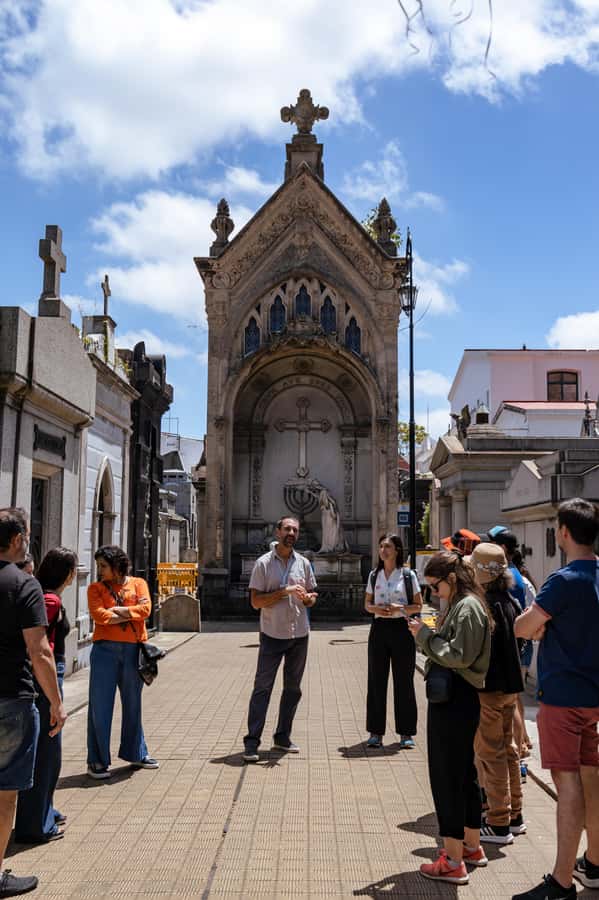
At $49 per person, the tour costs more than entering the cemetery and exploring alone. The admission fee of 22,600 Argentine pesos is added separately, so calculate the total before you reserve.
The question is what you receive for the extra money. You get 150 minutes with an English-speaking guide, a small group limited to 15, explanations of notable figures, architectural details, legends, and a visit to Evita’s mausoleum. You also avoid the common problem of looking at a map full of names without knowing which paths or tombs deserve your attention.
I think the price is fair for visitors who value context and storytelling. It is less compelling if you only want to photograph the most famous tombs and leave quickly. The tour’s value comes from the connections between the mausoleums, not from simple entry.
The booking terms add flexibility. You can cancel up to 24 hours before the tour for a full refund, and you can reserve now and pay later. Starting times vary, so check availability for your date.
Who will enjoy this cemetery tour most?
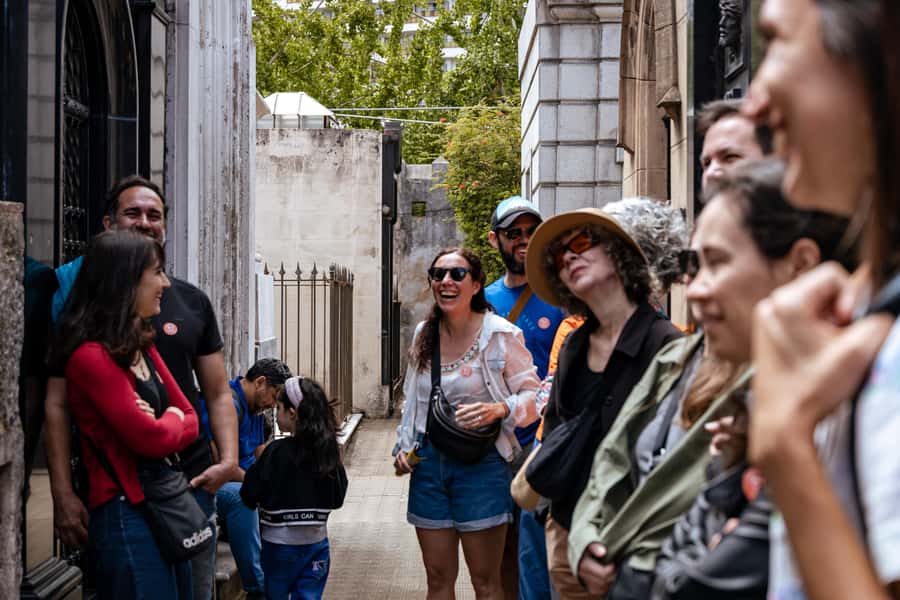
I would recommend it to anyone interested in Argentine politics, social history, art, architecture, religion, or unusual local stories. It also suits first-time visitors to Buenos Aires who want a guided introduction to Recoleta and the city’s elite past.
Families can bring children. The stories and sculptures offer plenty to discuss, and the guide has been praised for explaining things in a way a child could understand. The cemetery’s darker legends may appeal to older children, while younger ones may enjoy the visual details and dramatic buildings.
You should think twice if you dislike walking, have no interest in historical storytelling, or want a quiet solo visit. A guide changes the experience from private wandering to a shared, narrated route. That is the point, but it is not for everyone.
The tour also works well early in a Buenos Aires itinerary. It gives you names, symbols, and historical references that may help you understand other parts of the city later. I would leave time afterward to explore Recoleta on your own, visit nearby cafés, or simply think over the stories while the details are fresh.
Should you book the Recoleta Cemetery Secrets tour?
Book it if you want Recoleta Cemetery to make sense. The combination of a small group, clear English, strong storytelling, Evita’s mausoleum, and close attention to sculpture turns a beautiful but confusing site into a readable part of Buenos Aires.
I would be less quick to book if the extra entrance charge feels inconvenient or if you only have time for a brief photo stop. For most history-minded visitors, though, the 2.5-hour format and $49 price offer solid value, especially when the guide is Esteban and the group stays small.
Bring comfortable shoes, plan for the separate cemetery fee, and meet outside near La Biela with the blue cap in mind. If you do that, you will be prepared for a thoughtful, sometimes eerie, and often surprisingly funny walk through Argentina’s most famous cemetery.
FAQ
How long does the Recoleta Cemetery tour last?
The tour lasts 150 minutes, or 2.5 hours.
What is included in the tour price?
The price includes a guided tour of Recoleta Cemetery, stories and legends about notable figures, and a visit to Evita Perón’s mausoleum.
Is the cemetery entrance fee included?
No. The cemetery entrance ticket is not included and costs 22,600 Argentine pesos.
Where is the meeting point?
The group meets outside the cemetery at Plazoleta Chabuca Granda. If you take an Uber or taxi, use La Biela at Avenida Presidente Manuel Quintana 596 in Recoleta as the destination.
How will I recognize the guide?
The guide will be wearing a blue cap. Meeting details are also sent by WhatsApp before the tour.
What language is the tour in?
The tour is conducted in English by a live English-speaking guide.
How large is the group?
The group is limited to no more than 15 people.
Is the tour wheelchair accessible?
Yes, the activity is listed as wheelchair accessible. Contact the provider if you need details about the route or surfaces.
Can I cancel or pay later?
You can cancel up to 24 hours in advance for a full refund. You can also reserve your place and pay later.
Recently added around Buenos Aires
- Photo Session in Buenos Aires★ 5.0 · 26 reviews
- Your Personal Photographer in Buenos Aires★ 5.0 · 24 reviews
- Discover Buenos Aires’ independent art scene — Ticket included★ 5.0 · 30 reviews
- Your Private Photographer in Buenos Aires★ 5.0 · 4 reviews
- Yerba Mate Workshop – Learn to Drink Mate like a Local!★ 5.0 · 11 reviews
- Taste of Tradition: Yerba Mate & Alfajores Experience★ 4.0 · 5 reviews
- Wine tasting in OASIS Palermo★ 5.0 · 2 reviews
- Day Tour Classic★ 3.5 · 35 reviews
Historical Tours, compared.

Historical Sherpa Food Tour of San Telmo with Street Food, Drinks
Read our review →
Nazis in Buenos Aires: a historical walking tour
Read our review →

San Telmo: Historical Guided Tour with Street Food & Drinks
Read our review →
Private Evita and Peronism Historical Tour in Buenos Aires
Read our review →
Browse the lists this tour appears in