Reviewed · BUENOS AIRES TOURS
Recoleta & cemetery for curious people
Buenos Aires reveals itself one story at a time. This $25 walking tour links Plaza General San Martín with Recoleta Cemetery, using railway stations, grand palaces, immigrant neighborhoods, and old trees to explain how the city took shape. I like the clear historical thread, and I like that the guide continues into the cemetery when you choose to pay admission. The main drawback is that the walk depends on good weather, and the cemetery ticket costs extra.
The tour lasts about two to three hours and keeps its group to no more than eight people. Guides such as Nico, Ignacio, Nicola, and Sophia have been praised for making the walk feel like a lively conversation rather than a lecture. You should expect plenty of questions and discussion, though the small-group format means you may want a quieter alternative if you prefer to simply follow along.
In This Review
- Key points at a glance
- Why this is more than a Recoleta Cemetery tour
- Starting at Plaza General San Martín
- Retiro Station and Argentina’s export economy
- Torre Monumental and the British connection
- Edificio Kavanagh and the Belle Époque city
- Palacio San Martín and the fortunes of the Pampas
- Edificio Nicolás Mihanovich and European migration
- Plazoleta Carlos Pellegrini and the Jockey Club
- The Gomero de la Recoleta and the meaning of Recoleta
- Entering Recoleta Cemetery
- The guides make or break the experience
- Is $25 a fair price?
- Who should book this walking tour?
- Should you book it?
- FAQ
- How much does the tour cost?
- How long does the experience last?
- Where does the tour begin?
- Where does the tour end?
- Is entrance to Recoleta Cemetery required?
- How many people can join the tour?
- What happens if the weather is poor?
Key points at a glance
- A city story told through nine stops: The route connects Argentina’s export economy, British investment, wealthy landowners, immigration, and Recoleta’s social history.
- The cemetery is the finale: You reach Recoleta Cemetery with useful context before deciding whether to buy the entrance ticket.
- Small groups matter: A maximum of eight people makes it easier to hear the guide and ask questions.
- Guides are the star: Nico, Ignacio, Nicola, and Sophia are praised for humor, clear English, and strong command of local history.
- Good value at $25: Nearly three hours of guiding and a long walk through central Buenos Aires make this a fair price for curious visitors.
- Plan for weather and walking: The tour is outdoors, and poor weather can lead to cancellation or rescheduling.
Why this is more than a Recoleta Cemetery tour
The title points you toward Recoleta Cemetery, but the walk begins well before its famous tombs. That is the smart part of the design. If you arrive at the cemetery without context, you see ornate mausoleums and famous names. After this walk, you have a better idea of why such wealth gathered in Buenos Aires, how foreign money shaped the city, and why Recoleta became one of its grandest districts.
The route also gives you a useful introduction to Argentina’s past and present. It touches on export agriculture, British capital, European immigration, the old landowning class, and the city’s Belle Époque ambitions. These are not separate facts. The guide connects them, so the buildings become evidence of larger changes.
I especially like the focus on causes. At Retiro Station, you do not just look at a large railway building. You discuss why Argentina built such an extensive rail system and why British investors cared about it. At the palaces, you consider where the money came from and how landowners used it. That approach helps you read Buenos Aires instead of merely photographing it.
A few more Buenos Aires trips worth putting side by side
- Local Foodie Adventure in Buenos Aires with Sherpa Food Tours
★ 5.0 · 6,875 reviews - Buenos Aires City Private Tour with Local Guide
★ 5.0 · 3,475 reviews - Buenos Aires Small-Group City Tour
★ 5.0 · 2,226 reviews
Starting at Plaza General San Martín
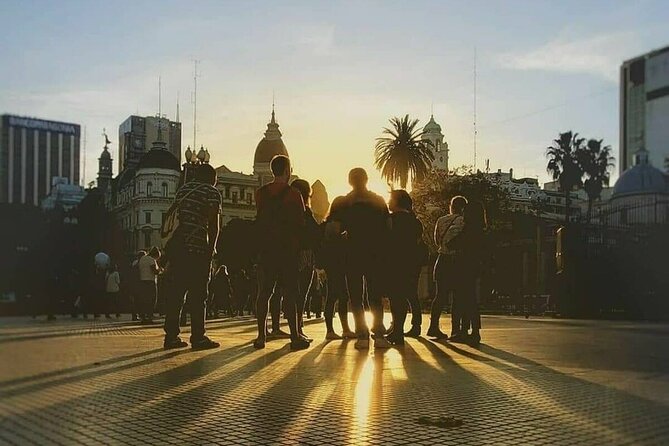
The meeting point is at Rapanui, Av. Santa Fe 772, near Plaza General San Martín. The plaza provides a fitting opening because the walk begins by looking backward in order to make sense of the city you see today.
You spend about 30 minutes here. The guide sets up the historical frame for the rest of the route, so this is not just a quick gathering point. Expect an explanation of how Buenos Aires developed and why the city’s past still shapes its present.
This first stop matters because the tour is not built around isolated attractions. You are being given a way to connect the city’s public spaces, transport network, architecture, and social divisions. If you are new to Buenos Aires, this early orientation can help you understand later stops.
The starting location is near public transportation, and the route then continues on foot. Wear comfortable shoes. The total time is not extreme, but the tour covers several neighborhoods and includes steady outdoor walking.
Retiro Station and Argentina’s export economy
The walk continues to Estación Retiro San Martín, described as the largest train station in Latin America. The stop lasts about 20 minutes and explores one of the most useful themes on the route: Argentina’s export-oriented agricultural economy.
The railway system was not simply a way to move people around the country. It helped connect productive land with ports and commercial centers. The guide explains why Argentina developed such a large rail network and why British capital played such a strong role in that development.
You do not need a background in economics to enjoy this stop. The station gives the subject a physical setting. Instead of hearing a general lecture about foreign investment, you are looking at infrastructure connected to trade, land, and wealth.
This is one of the places where the tour earns its price. A casual walk might take you past the station without asking why it exists in such a grand form. Here, the building becomes part of a larger explanation of Argentina’s growth and its ties to Europe.
Torre Monumental and the British connection
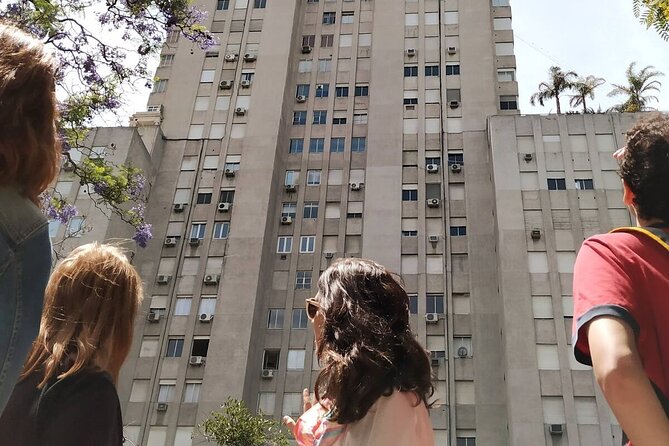
Torre Monumental receives about 10 minutes. The stop introduces the British community in Buenos Aires and explains why so many British interests became established in Argentina.
The tower is a compact stop, but it helps continue the railway discussion. British involvement was not limited to one industry or one building. The guide uses the tower to discuss the people and institutions behind that wider connection.
You should not expect a long visit inside the monument. The value is in the explanation offered from the route. This is a good example of how the tour works: short stops can carry more weight when they connect to what came before.
Still Argentina, but a completely different sort of afternoon:
- Buenos Aires Hop-On Hop-Off Bus, Free Walking Tours & Discounts
★ 4.5 · 2,218 reviews - Buenos Aires: Piazzolla Tango Show with Optional Dinner
★ 4.4 · 2,122 reviews - Buenos Aires: City Highlights Guided Tour with Transfer
★ 4.7 · 1,946 reviews - Buenos Aires: Hop-On Hop-Off City Bus Tour
★ 4.2 · 1,855 reviews
Edificio Kavanagh and the Belle Époque city
At Edificio Kavanagh, the guide discusses the Belle Époque and the way it changed Buenos Aires. You spend around 10 minutes here, looking at an architectural symbol of the city’s desire to present itself as wealthy, modern, and European.
The tour also addresses the role of large landowners in Argentina’s development. That pairing is important. The beautiful buildings were not created by architecture alone. They were linked to money, land, trade, and the ambitions of an elite class.
I like this part because it avoids treating the city’s grand architecture as decoration without a backstory. You are encouraged to ask who paid for these buildings, where the wealth came from, and what kind of society they represented.
The stop is brief, so the guide cannot provide a full architectural study. Still, the short visit works well within the larger route. You see the building, hear its place in the city’s story, and keep moving.
Palacio San Martín and the fortunes of the Pampas
The next stop, Palacio San Martín, also lasts about 10 minutes. Here, the focus shifts more directly to the palaces built by landowners from the Pampas.
The guide explains how these families acquired large amounts of arable land and where they spent their wealth. That question gives the tour an honest edge. You are not only admiring elegant façades. You are examining the economic system that made such display possible.
For me, this is one of the strongest ideas in the walk. Buenos Aires can look like a city of grand European-style buildings, but those buildings were paid for by Argentina’s own land and export economy. The route makes that connection visible.
If you enjoy social and economic history, you will likely appreciate the subject. If you want only famous sights and quick photos, this stop may feel more serious than expected. That is part of the bargain here: the tour asks you to think about privilege as well as beauty.
Edificio Nicolás Mihanovich and European migration
At Edificio Nicolás Mihanovich, the guide introduces the arrival of Austro-Hungarians and Yugoslavians in Buenos Aires. The stop lasts about 20 minutes, giving this theme more time than several of the architectural stops.
This broadens the story beyond British influence and the Argentine elite. Buenos Aires was also shaped by Europeans who arrived in large numbers for different reasons and built new lives in the city. The guide explains why people from these parts of Europe came to Argentina in such numbers.
The stop helps you see immigration as more than a general background fact. It becomes part of the city’s streets, buildings, occupations, and culture. You may leave with a better sense of why Buenos Aires has such a strong European character without being simply a European city transplanted to South America.
The guide’s conversational style is useful here. Several people have praised Nico and Ignacio for answering many questions without making the walk feel like a classroom. If you are the sort of person who wants to ask how politics, economics, and migration fit together, this tour gives you room to do so.
Plazoleta Carlos Pellegrini and the Jockey Club
The route reaches Plazoleta Carlos Pellegrini for about 10 minutes. The Jockey Club becomes the subject, with a reminder that the Pampas represented more than cattle and sheep.
This is a small but telling correction to a familiar image of Argentina. The country’s rural wealth was tied to social clubs, status, horse racing, and urban power, not only to work on the land. The guide uses the Jockey Club to show another side of the elite culture that shaped Buenos Aires.
The stop also helps break up the longer explanations. You continue learning about the same social world, but through a different institution. It is a good example of the tour’s method: each building or public space opens a new window on the same national story.
The Gomero de la Recoleta and the meaning of Recoleta
At the Gomero de la Recoleta, you spend about 10 minutes discussing why the neighborhood is called Recoleta and where the area’s enormous trees came from.
This may seem like a lighter stop after economics, migration, and land ownership, but it adds useful texture. Neighborhood names and mature trees can tell you about religious origins, urban planning, and the way a district changed over time.
The large trees also soften the grand architecture. Recoleta is famous for monuments and expensive buildings, yet its character is not only stone and status. The guide points out the natural features that help give the area its particular feel.
This part should appeal to you if you like small details that you might miss alone. It is not a major landmark in the usual sense. It is the sort of stop that makes a guided walk more rewarding than a checklist of attractions.
Entering Recoleta Cemetery
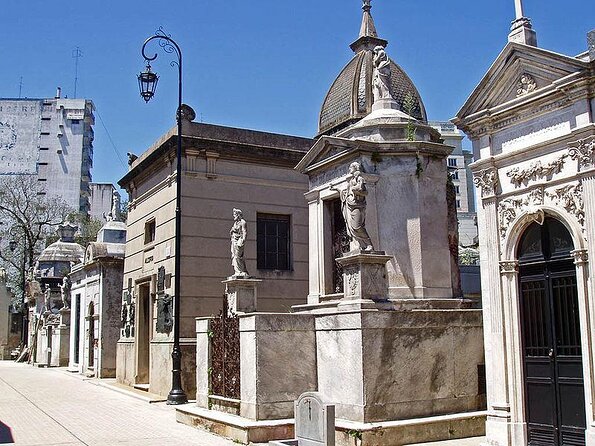
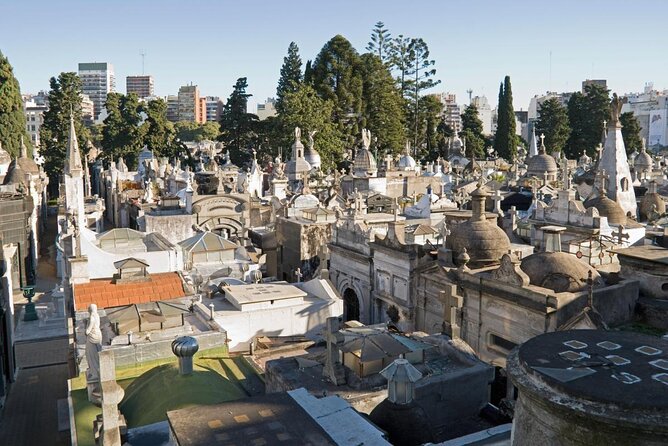
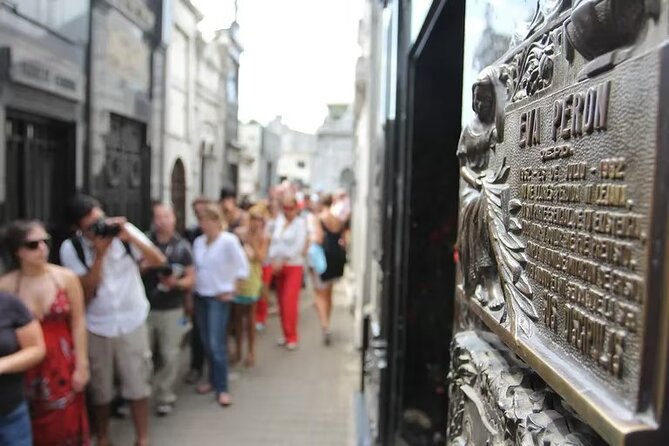
The tour finishes at Recoleta Cemetery, where the guide introduces its inhabitants and the mysteries connected with the site. The cemetery visit itself lasts about 20 minutes, and entrance is optional.
The admission ticket is not included in the $25 price. That is worth knowing before you arrive. If you want the guide to continue inside, budget separately for entry. The supplied details indicate that the route ends at the cemetery and that the guide goes inside with the group when the visit is chosen.
This arrangement gives you flexibility. You can finish at the entrance if you have had enough walking, or pay to continue and use the historical background you have gathered along the way. I would favor entering, since the cemetery is the payoff for the earlier discussion of landowners, wealth, immigration, and Buenos Aires society.
You will encounter famous names and elaborate tombs, but the guide’s role is to explain the people and the stories behind them. The cemetery becomes more than a collection of dramatic stone structures. It shows how Argentina’s powerful families wanted to be remembered and how public memory works in Buenos Aires.
Do not treat the cemetery as a completely separate attraction. Its meaning depends on the route that leads to it. The earlier stops explain the money, politics, and social order that made this extraordinary burial ground possible.
The guides make or break the experience
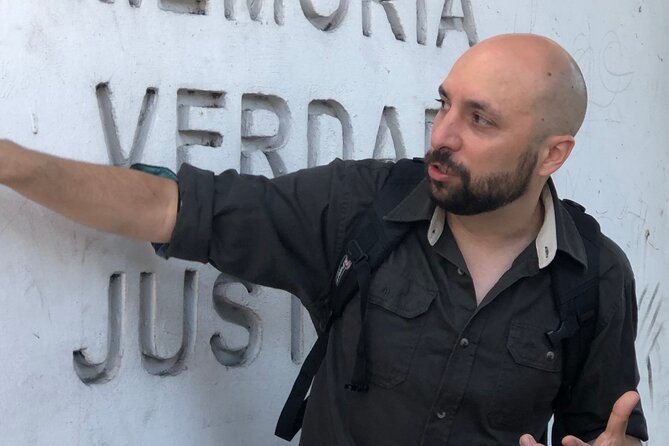
The strongest feature is the guiding. Nico, also referred to as Nicholas or Nickolas, receives repeated praise for his passion, humor, and clear English. Ignacio is described as entertaining and able to connect past events with current Buenos Aires. Nicola is singled out for telling stories people could happily hear for much longer, while Sophia is praised for spending three hours sharing a story behind each place.
The common thread is conversation. You should expect questions, explanations, and discussion rather than a memorized speech delivered at full speed. That suits curious people who want to ask about politics, economics, architecture, or culture.
This style is not likely to suit everyone. One person who described themselves as an introvert worried about the interactive format, but found it enjoyable and manageable. That suggests the conversation is friendly rather than intimidating, though you should still expect some participation.
The small maximum of eight people helps. A guide can hear your question, adjust the explanation, and keep the group together without shouting across a crowd. It also makes the experience feel more personal than a large city walk.
Is $25 a fair price?
At $25 per person, this is good value if you want context rather than a simple route from one sight to another. The walk lasts two to three hours, includes a university graduate guide, and covers nine stops in several central areas.
The cost does not include entry to Recoleta Cemetery. Since the cemetery visit is optional, the separate ticket is not unreasonable, but you should factor it into your budget if you want the full experience.
The tour is especially good value early in your Buenos Aires stay. It can help you understand the city before you visit other areas, and one person considered it the ideal introduction to the country. Booking around 31 days ahead is common, so do not leave it until the last morning if your schedule is fixed.
The cancellation terms are practical. You can cancel for a full refund up to 24 hours before the start time. Poor weather can cancel the tour, with a different date or full refund offered. One guest arrived after a cancellation message apparently failed to reach them, so check your booking communication and weather updates before setting out.
Who should book this walking tour?
I would choose this tour if you want to understand Buenos Aires through its buildings and social history. It suits couples, friends, solo visitors, and families who enjoy asking questions and walking at a steady pace.
It is also a strong choice for nerdy travelers in the best sense. The subjects include railways, British investment, land ownership, immigration, architecture, clubs, neighborhood names, and cemetery stories. You get a lot more than a collection of famous photo stops.
You may want something else if you dislike outdoor walking, prefer a fixed script, or have no interest in the forces behind Buenos Aires architecture. The weather requirement also matters. This is not an indoor museum tour that works regardless of rain or heat.
Service animals are allowed, and the route is near public transportation. Most people can participate, but the information provided does not give a detailed mobility assessment, so ask the provider if you have specific access needs.
Should you book it?
Book this tour if Recoleta Cemetery interests you but you want to understand the city around it first. The route gives you a useful chain of ideas: agricultural exports supported wealth, foreign capital helped build infrastructure, immigrants reshaped the city, and elite families turned their fortunes into palaces and monuments.
The best reason to choose it is the guide-led conversation. You are not left to admire Buenos Aires from the outside. You are encouraged to ask why it looks this way, who benefited, and how the past still affects the present.
At $25, with a small group and up to three hours of guiding, I consider it a strong buy. Pay extra for the cemetery if you want the complete ending, bring comfortable shoes, watch the weather, and book ahead. For a curious first look at Buenos Aires, this is a thoughtful and unusually useful walk.
FAQ
How much does the tour cost?
The tour costs $25 per person. Admission to Recoleta Cemetery is not included.
How long does the experience last?
The walk lasts approximately two to three hours.
Where does the tour begin?
It begins at Rapanui, Av. Santa Fe 772, in Buenos Aires.
Where does the tour end?
It ends at Recoleta Cemetery, Junín 1760. The guide can continue inside the cemetery when you choose to enter.
Is entrance to Recoleta Cemetery required?
No. Entrance is optional, and the cemetery ticket is paid separately.
How many people can join the tour?
The group has a maximum of eight participants.
What happens if the weather is poor?
The experience requires good weather. If it is canceled because of weather, you will be offered another date or a full refund.
Recently added around Buenos Aires
- Photo Session in Buenos Aires★ 5.0 · 26 reviews
- Your Personal Photographer in Buenos Aires★ 5.0 · 24 reviews
- Discover Buenos Aires’ independent art scene — Ticket included★ 5.0 · 30 reviews
- Your Private Photographer in Buenos Aires★ 5.0 · 4 reviews
- Yerba Mate Workshop – Learn to Drink Mate like a Local!★ 5.0 · 11 reviews
- Taste of Tradition: Yerba Mate & Alfajores Experience★ 4.0 · 5 reviews
- Wine tasting in OASIS Palermo★ 5.0 · 2 reviews
- Day Tour Classic★ 3.5 · 35 reviews
Buenos Aires Tours, compared.
Local Foodie Adventure in Buenos Aires with Sherpa Food Tours
Read our review →
Buenos Aires City Private Tour with Local Guide
Read our review →
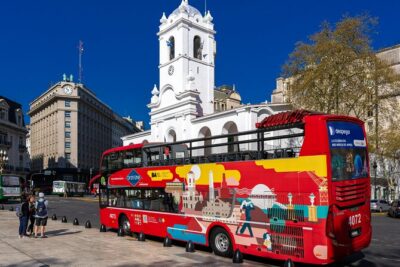
Buenos Aires Hop-On Hop-Off Bus, Free Walking Tours & Discounts
Read our review →