
Reviewed · PRIVATE TOURS IN BUENOS AIRES
Private Architecture and Palaces Tour in Buenos Aires
Look up and Buenos Aires tells its story. This private three-hour tour links grand palaces, theaters, galleries, and civic buildings across the city, turning a sightseeing drive into a lesson in Argentine ambition. I especially like the hotel pickup and drop-off, which saves time in a spread-out city, and the way guides such as Alexandra, Julieta, Carolina, Julia, and Mariella have tailored stops to each group. The main drawback is the pace: about ten minutes at each of nine locations means you will see many façades, but only a few interiors.
You pay $140 per person, so this is not the cheapest way to see Buenos Aires. Still, for a private group with a car, driver, and guide, the price can make sense if you want context, photographs, and the freedom to ask questions rather than follow a large bus tour. The tour is often reserved about 63 days ahead, a useful signal to book early if your dates are fixed.
In This Review
- Key points before you book
- Why this private format works in Buenos Aires
- Barolo Palace: Dante, concrete, and a lighthouse
- Congress and the civic face of Argentina
- Teatro Colón and the limits of a quick exterior visit
- Palacio de Aguas Corrientes: the city’s decorated water tank
- Palacio Paz and the power of Beaux-Arts Buenos Aires
- San Martín Palace and the Anchorena family
- The French Embassy and academic elegance
- Galería Güemes and early reinforced concrete
- El Ateneo Grand Splendid, a theater reborn as a bookstore
- Guides, language, and how personal the tour feels
- Is $140 per person good value?
- Who should book this tour?
- Should you book the Buenos Aires palaces tour?
- FAQ
- How long is the private architecture tour?
- Does the tour include hotel pickup and drop-off?
- Is this a private tour?
- Is admission to Teatro Colón included?
- Is the tour suitable for children?
- What is the cancellation policy?
Key points before you book
- Nine major buildings in three hours: You cover Monserrat, Congreso, downtown, Retiro, and Recoleta without spending the day on foot.
- Private service matters: Only your group participates, so the guide can adjust the route, timing, language, and discussion to your interests.
- The Barolo Palace is the star: Its Dante-inspired design, reinforced-concrete structure, and rooftop lighthouse give the tour a memorable opening.
- You get out of the vehicle: The format includes short walks and photo stops, not just a view through the window.
- Teatro Colón admission costs extra: The theater is included as an exterior stop unless you arrange or purchase an entrance separately.
- Guides add city advice: Alexandra, Julieta, Carolina, Julia, and Mariella have been praised for explaining architecture alongside Argentine culture, politics, and other places to visit.
Why this private format works in Buenos Aires
Buenos Aires is a city of grand avenues, ornate apartment blocks, former aristocratic residences, and public buildings built during a period of enormous confidence. Much of that architecture is easy to pass without understanding. A guide helps you connect the French façades, Italian influences, Art Nouveau details, and civic monuments to the city’s changing fortunes.
The private setup is the strongest practical feature. You are not tied to the interests or pace of a large group. If you want more time for photographs, a closer look at ornament, or a short explanation of Argentine politics, you can ask. One guide adjusted the route for a group that had already walked around Buenos Aires, pointing out details they had missed.
Transportation also changes the day. The stops are spread across several neighborhoods, and moving by vehicle lets you cover more ground than a walking tour. The driver handles the city traffic while the guide focuses on the buildings. Several people specifically appreciated the smooth transfers and the chance to leave the car at selected stops.
The advertised duration is about three hours. That is enough for a broad introduction, not a specialist study of every palace. Expect roughly ten minutes at each listed stop, with the actual time shaped by traffic, photo requests, and whether you enter a building. If you want a slow architectural survey, you may prefer to follow this tour with a self-guided walk.
More Private Tours in Buenos Aires
- Buenos Aires City Private Tour with Local Guide
★ 5.0 · 3,475 reviews - Private Airport Transfer In or Out : Ezeiza (EZE) – Buenos Aires
★ 5.0 · 548 reviews - Private Full-Day Iguazu Falls Tour with Airfare from Buenos Aires
★ 4.5 · 387 reviews
Barolo Palace: Dante, concrete, and a lighthouse
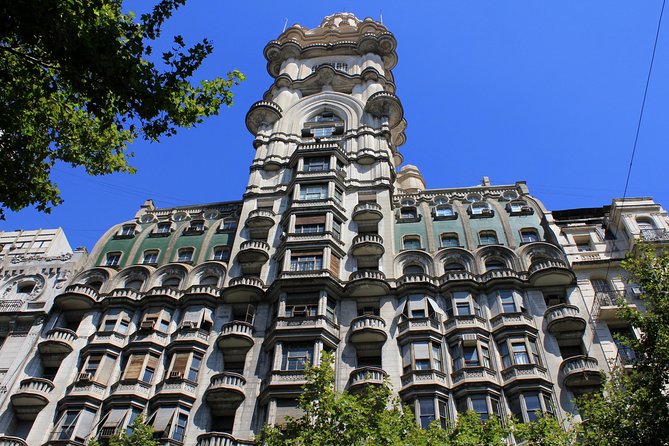
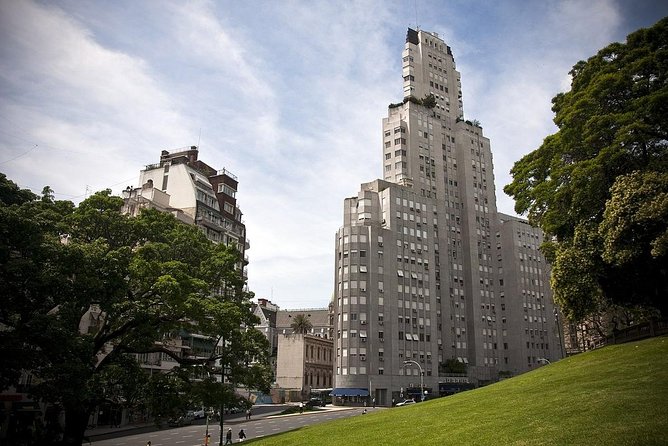
The tour begins with one of Buenos Aires’ most unusual buildings, Palacio Barolo in Monserrat. Designed by Italian architect Mario Palanti for businessman Luigi Barolo, it was once the tallest building in South America, before the Kavanagh Building took that title in 1935.
Its engineering was remarkable for the period. The Barolo was the first reinforced-concrete building in Argentina to reach almost 100 meters. The structure rises to a revolving lighthouse on the twenty-second floor. In 1923, its powerful beam transmitted the result of the world heavyweight boxing match between Luis Ángel Firpo and Jack Dempsey in New York.
The oddest and most appealing detail is the building’s connection to Dante Alighieri. Palanti and Barolo admired the Italian poet, and the design is divided into three broad parts corresponding to hell, purgatory, and heaven in the Divine Comedy. The references do not stop there. Palanti also looked to Indian architecture, including Jaipur’s Palace of the Winds and the Rajarani Temple in Bhubaneshwar.
You will probably spend about ten minutes here, so listen closely. This is a building where the story is almost as important as the façade. The lighthouse was restored in 2010 for Argentina’s bicentennial celebrations, giving the upper section renewed life.
Admission to the exterior stop is free. If you want a more detailed visit inside the building or access to the lighthouse, confirm what is available when booking, since the tour information only includes the stop itself.
Congress and the civic face of Argentina
The Palace of the Argentine National Congress is a grand neoclassical building on a large block bounded by Rivadavia, Combate de los Pozos, Entre Ríos, and Hipólito Yrigoyen avenues. It houses the country’s national legislature and is described as one of the largest congress complexes in the world.
This stop gives the tour a useful change of focus. Palacio Barolo reflects private enterprise and artistic symbolism. Congress represents the state, public power, and the formal image Argentina wanted to project. You will likely spend ten minutes here, mainly taking in the scale and exterior details.
Because the stop is short and no entrance fee is included, do not expect a full parliamentary visit. The value comes from seeing the building in relation to the surrounding city and hearing the guide explain how it fits into Buenos Aires’ civic center.
Teatro Colón and the limits of a quick exterior visit
Teatro Colón is one of the great opera houses of the world, famous for its acoustics and ornate early twentieth-century design. The present building opened in 1908 with Giuseppe Verdi’s Aida, after a construction period of roughly twenty years.
The original plan was far more ambitious. Its foundation stone was laid on May 25, 1890, with the aim of opening before October 12, 1892, the four-hundredth anniversary of the arrival of Columbus in the Americas. Delays pushed the opening much later, but the result became one of Buenos Aires’ defining cultural buildings.
The theater’s style is eclectic, drawing on several European traditions rather than following one strict model. That makes it especially useful on an architecture tour. Your guide can point out how Buenos Aires borrowed and reshaped European ideas instead of simply copying them.
The exterior stop is free, but entrance to Teatro Colón is not included. One group was able to fit in a theater tour at the right time after the guide adjusted the half-day schedule. That shows the benefit of a private arrangement, but you should not assume an interior visit is part of the standard three-hour outing. If seeing the auditorium is essential, ask about timing and ticket arrangements before you pay.
A few more Buenos Aires trips worth putting side by side
- Local Foodie Adventure in Buenos Aires with Sherpa Food Tours
★ 5.0 · 6,875 reviews - Buenos Aires Small-Group City Tour
★ 5.0 · 2,226 reviews - Buenos Aires Hop-On Hop-Off Bus, Free Walking Tours & Discounts
★ 4.5 · 2,218 reviews - Buenos Aires: Piazzolla Tango Show with Optional Dinner
★ 4.4 · 2,122 reviews
Palacio de Aguas Corrientes: the city’s decorated water tank
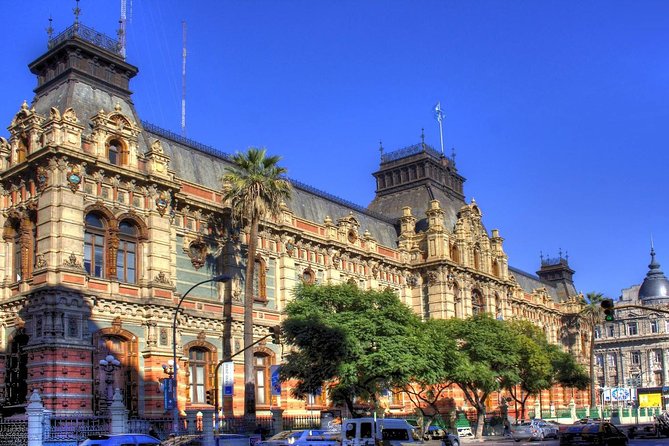
Palacio de Aguas Corrientes may be the most surprising stop. Built to house water-supply tanks for Buenos Aires’ growing population, it hides an industrial purpose behind one of the city’s most elaborate façades.
The building was designed by Norwegian architect Olaf Boye, who worked with local architects including Juan Antonio Buschiazzo, Adolfo Büttner, and Carlos Altgelt. Its exterior uses imported materials and thousands of colorful ceramic pieces, with a profusion of ornament that makes an ordinary utility structure look like a palace.
The style is linked to the Second French Empire, a look that appealed to Argentina’s upper classes in the late nineteenth century. That contrast is the point: behind the decoration was essential urban infrastructure. Buenos Aires was modernizing quickly, and even its water system received a monumental public face.
You will have about ten minutes here. It is a good place to pay attention to small details rather than only the overall shape. The façade rewards photographs, but the guide’s explanation helps you see why this building matters beyond its looks.
Palacio Paz and the power of Beaux-Arts Buenos Aires
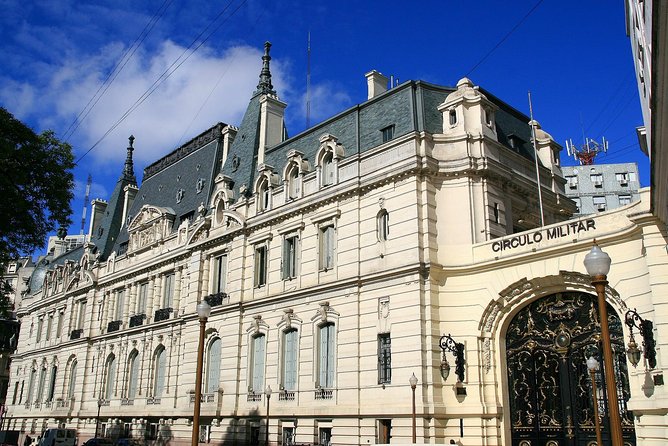
Palacio Paz, facing Plaza San Martín on Avenida Santa Fe, was once the city’s largest and most luxurious private residence. It was built for José C. Paz and reflects the Beaux-Arts taste of Buenos Aires at the beginning of the twentieth century.
The building expresses the wealth and social position of the family that commissioned it. Its scale also helps explain the nickname Paris of South America, though that comparison can hide the city’s own character. The tour is more useful when it shows how local families adopted European architectural styles to announce status in Argentina.
Since 1938, the palace has been the headquarters of the Military Circle. You will see the outside during the short stop, with no entrance fee included. If you enjoy grand residences, allow extra time on another visit, because ten minutes is enough for an introduction but not a full look at the interior.
San Martín Palace and the Anchorena family
Across from Plaza San Martín, Palacio San Martín serves as the ceremonial seat of Argentina’s Ministry of Foreign Affairs. Architect Alejandro Christophersen designed the fine-arts-style palace in 1905 for Mercedes Castellanos de Anchorena, a member of one of the city’s leading aristocratic families.
The Anchorena family opened the palace to mark the centenary of Argentine independence. It remained known as Anchorena Palace until the government acquired it in 1936 and renamed it Palacio San Martín.
This stop pairs naturally with Palacio Paz. Both show how Buenos Aires’ elite built lavish residences, but the later government use of Palacio San Martín adds another chapter. Private wealth became part of the official image of the nation.
You will see the exterior for around ten minutes. It is free to view from outside, and the location opposite the plaza makes it easy to understand the palace within the wider Retiro setting.
The French Embassy and academic elegance
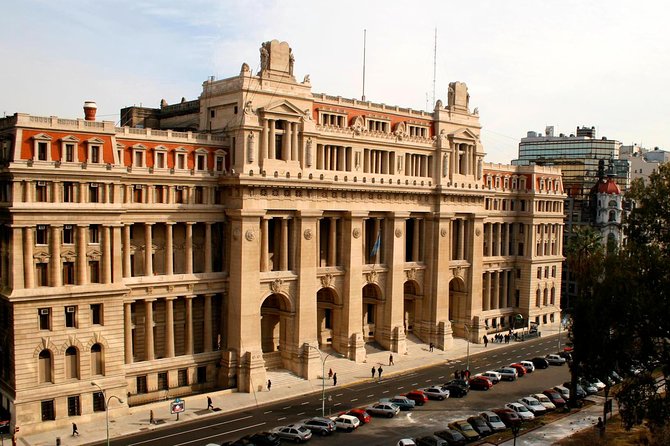
The former Ortiz Basualdo-Zapiola residence now houses the Embassy of France. Built between 1912 and 1918, it is considered one of the clearest examples in Buenos Aires of French academic architecture.
The house includes a mix of styles, reflecting the artistic preferences of the period. That variety gives your guide a chance to explain how architects combined references rather than working within one neat category. As with several stops, the interest is in learning to read the façade: proportion, decoration, symmetry, and the signals of wealth.
Because the building is an embassy, the visit is an exterior look rather than a casual interior tour. The short stop works well as part of a sequence through Retiro, where several major residences and institutions are close together.
Galería Güemes and early reinforced concrete
Galería Güemes links Florida and San Martín streets through an Art Nouveau interior passage lined with shops on two levels. Opened in 1915, it is also regarded as one of Argentina’s first skyscrapers and the country’s first building constructed entirely of reinforced concrete.
The gallery is named for General Martín Miguel de Güemes, a hero of the Argentine War of Independence and a leader associated with the gaucho war. That name adds a national reference to a building that otherwise feels strongly tied to modern urban commerce.
This stop is more than a quick look at another ornate façade. You can see how Buenos Aires adapted new construction methods for mixed-use city life, combining a pedestrian passage, shops, and vertical development.
The gallery is in the heart of downtown, where the tour’s vehicle-based format is particularly useful. You get a short orientation to the building without having to plan a separate route between the other central stops.
El Ateneo Grand Splendid, a theater reborn as a bookstore
The final stop is El Ateneo Grand Splendid on Santa Fe Avenue in Recoleta. The building is now a bookstore, but it began as the National North Theater. In 1917, it became the Grand Splendid, an ambitious theater of the early twentieth century.
Its soft lighting, decorated details, and large stained-glass window give it a calm atmosphere despite its busy commercial setting. The former stage and theater layout help explain why the bookstore feels unlike an ordinary shop. Books now occupy the space where performances once took place.
This is one stop where you can enjoy the building without needing a long lecture. The architecture is easy to appreciate at a glance, and the change from theater to bookstore makes it memorable. The tour information lists admission as free, so you can enter and look around during the stop.
It is also a good ending because it shifts the story from palaces and official buildings to a public cultural space. You finish with a place people still use, not only a façade preserved from another age.
Guides, language, and how personal the tour feels
The strongest part of this experience is the guide. Alexandra was praised for adapting the day for a honeymooning couple and offering ideas for the rest of their visit. She also speaks several languages, according to the feedback provided, which may help if you want the tour in a language other than English.
Julieta was praised for her command of Buenos Aires and Argentine history. Julia added information about nearby buildings, not just the nine scheduled stops. Mariella adjusted the tour around a group’s interests and allowed people to leave the car for photographs when they wished. Carolina was described as delivering a highly personal route based on the group’s needs.
Guide assignments can change, so you should not book expecting one particular person unless the operator confirms it. The consistent advantage is the private structure. You can ask about architecture, culture, politics, food, or what to see next, and the guide can shape the conversation around you.
One useful example is the recommendation of Recoleta Cemetery after the tour. That sort of advice can turn a three-hour introduction into a better full day, especially if you are new to Buenos Aires.
Is $140 per person good value?
At $140 per person, the tour costs more than a group sightseeing outing or a do-it-yourself walk through downtown. You are paying for a private guide, private transport, hotel pickup and drop-off, and the ability to adjust the route.
The value is strongest for a small group that wants comfort and personal attention. If four people share the experience, the cost may feel more reasonable than hiring separate transport and trying to connect distant neighborhoods alone. It is also useful after a long flight, when a hotel pickup and a guided overview help you get your bearings without dealing with city logistics immediately.
The value is weaker if you mainly want to enter Teatro Colón or spend a long time inside each building. Entrance fees are not included, food and drinks are not included, and the itinerary gives about ten minutes per stop. You could visit some areas independently for less, but you would give up the guide’s explanations and the efficient vehicle route.
Free cancellation is available up to 24 hours before the start time for a full refund. Changes or cancellations inside that window are not accepted for a refund. Most people can participate, and the tour is described as suitable for children.
Who should book this tour?
I would choose this tour if you want a broad architectural introduction in one morning or afternoon. It suits first-time visitors, couples, families, and anyone who wants to understand Buenos Aires through buildings rather than only through food or neighborhood walks.
It is also a good fit if you have limited time. You see Monserrat, Congreso, downtown, Retiro, and Recoleta in one compact outing, with a guide filling in the gaps between locations.
Architecture students and serious design fans may enjoy it, but should ask for a slower or longer format. One group with a student in a master’s architecture program found the guide able to explain important design points and adjust the schedule. Still, the standard pace is an overview.
I would skip it if you dislike vehicle-based sightseeing, want a long walking tour, or care most about interior access. In that case, use the tour as a starting point and spend another day exploring Teatro Colón, Galería Güemes, Palacio Paz, or Recoleta at a slower pace.
Should you book the Buenos Aires palaces tour?
Book it if you want personal guidance, comfortable transfers, and a strong overview of the city’s grand architecture. The Barolo Palace, Palacio de Aguas Corrientes, Galería Güemes, and El Ateneo Grand Splendid give the route real variety, while the private format lets you stop for photographs and ask questions.
Before booking, confirm the exact duration and ask about any interior visits, especially Teatro Colón. If you value context and convenience more than extended time inside each building, the $140 price is defensible. If you prefer to explore slowly and independently, take the building list and create your own walking days instead.
FAQ
How long is the private architecture tour?
The guided tour lasts approximately three hours.
Does the tour include hotel pickup and drop-off?
Yes. Hotel pickup and drop-off are included.
Is this a private tour?
Yes. Only your group participates.
Is admission to Teatro Colón included?
No. The entrance fee for Teatro Colón is not included. Other attraction entrance fees are also excluded where required.
Is the tour suitable for children?
Yes. The tour is described as kid-friendly, and most people can participate.
What is the cancellation policy?
You can cancel at least 24 hours before the experience begins for a full refund. Cancellations or changes made less than 24 hours before the start time are not accepted for a refund.
Recently added around Buenos Aires
- Photo Session in Buenos Aires★ 5.0 · 26 reviews
- Your Personal Photographer in Buenos Aires★ 5.0 · 24 reviews
- Discover Buenos Aires’ independent art scene — Ticket included★ 5.0 · 30 reviews
- Your Private Photographer in Buenos Aires★ 5.0 · 4 reviews
- Yerba Mate Workshop – Learn to Drink Mate like a Local!★ 5.0 · 11 reviews
- Taste of Tradition: Yerba Mate & Alfajores Experience★ 4.0 · 5 reviews
- Wine tasting in OASIS Palermo★ 5.0 · 2 reviews
- Day Tour Classic★ 3.5 · 35 reviews
Private Tours in Buenos Aires, compared.
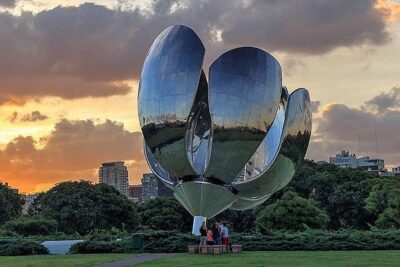
Buenos Aires City Private Tour with Local Guide
Read our review →
Private Airport Transfer In or Out : Ezeiza (EZE) – Buenos Aires
Read our review →
Private Full-Day Iguazu Falls Tour with Airfare from Buenos Aires
Read our review →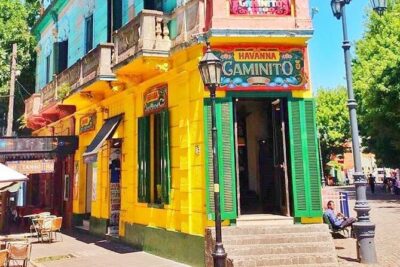
Private City Tour with a friend in Buenos Aires
Read our review →
Private Tour: Buenos Aires and Delta del Tigre with Local Guide
Read our review →
Full Day Buenos Aires Private Walking Tour – Your Own Personal BA 101
Read our review →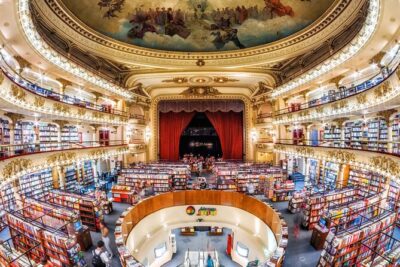
Buenos Aires Private City Tour with Local Guide
Read our review →
Browse the lists this tour appears in