
Reviewed · BARILOCHE TOURS
Bariloche: Puerto Blest and Cascada de los Cántaros (Waterfall of the Cantaros)
Two waterways, one superb day in Patagonia. This seven-hour excursion combines a smooth catamaran ride across Nahuel Huapi with a walk through ancient larch forest to Cascada de los Cántaros. I like the mix of open water and rainforest, and I especially like that the route reaches both Puerto Blest and Lake Frias, rather than stopping at just one scenic point. The main drawback is value: at $218 per person, you still need to budget for the National Park entry fee and the boarding charge.
The route also carries a little logistical risk. Pickup is arranged from many hotels and gates along Bariloche’s main hotel corridor, but the vehicle may collect people headed for different outings, which can make the start feel crowded or confusing. English commentary may also be limited, despite English being listed among the available languages.
In This Review
- Key points to know before you book
- From Bariloche hotels to Puerto Pañuelo
- Sailing west across Nahuel Huapi
- Walking to Cascada de los Cántaros
- Puerto Blest and the short crossing to Lake Frias
- Returning across the lake
- Is $218 a fair price?
- Who will enjoy this day most?
- Should you book Puerto Blest and Cascada de los Cántaros?
- FAQ
- How long does the Puerto Blest and Cascada de los Cántaros excursion last?
- Where does pickup take place?
- What languages are offered?
- Are National Park fees included?
- Is the catamaran ticket included?
- Can I cancel the booking?
Key points to know before you book
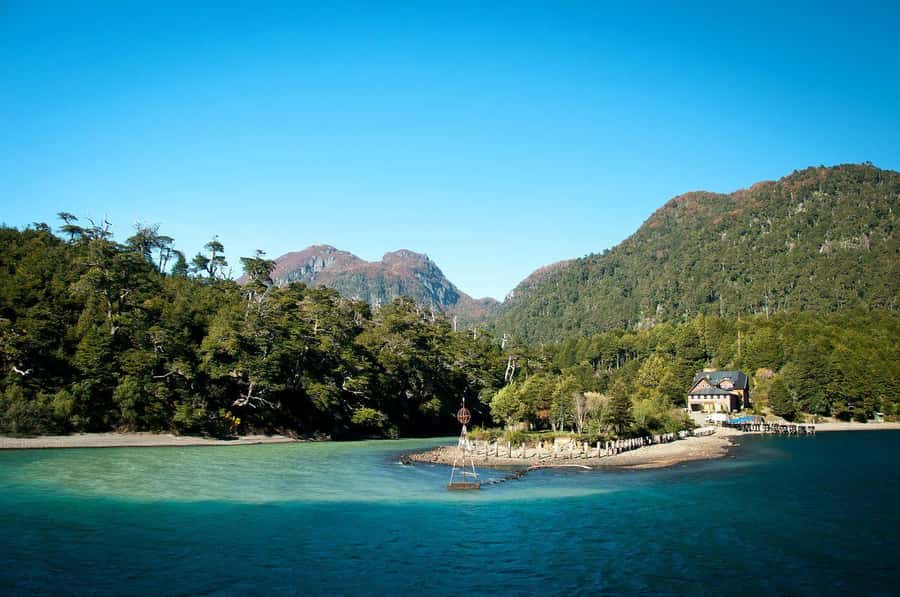
- The boat ride is the heart of the day: You spend about two hours aboard a catamaran on the outward and return legs across Nahuel Huapi.
- Cascada de los Cántaros requires a forest walk: The trail leads through lush Valdivian rainforest and ancient larch trees to Cantaros Lake.
- Puerto Blest adds a second setting: After the waterfall, you have time to see the bay and the shores of Lake Frias.
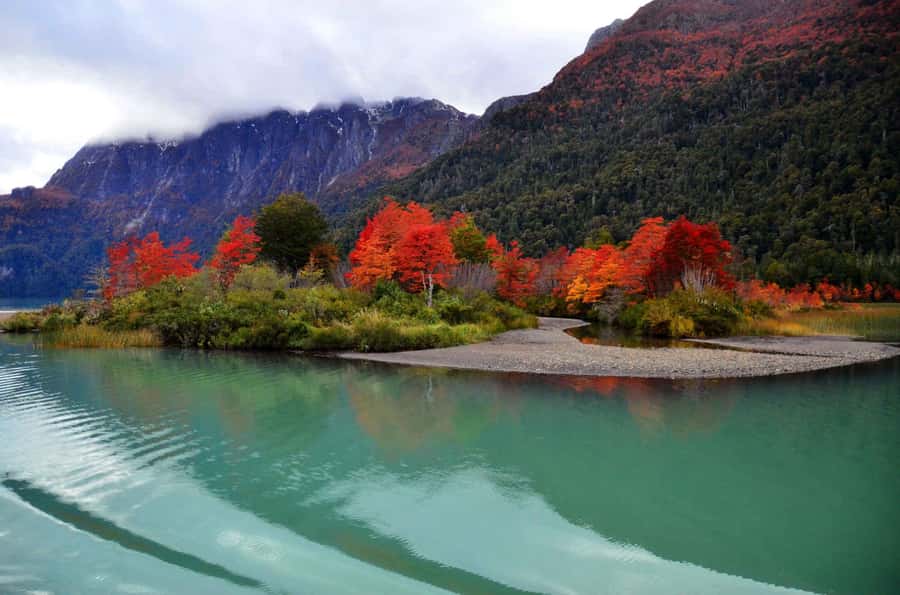
- Cerro Tronador supplies the color: Lake Frias gets its striking green water from glaciers on the mountain that forms part of the Argentina-Chile border.
- The advertised price is not the complete cost: National Park admission is about $20, and the boarding fee is about $5, payable locally in cash or by debit.
- Language service can vary: Spanish, English, and Portuguese are offered, but English explanations may be brief on some departures.
From Bariloche hotels to Puerto Pañuelo
Your day begins with a van transfer of about 45 minutes. Pickup points cover a long stretch of Bariloche, from central locations such as the Turisur office on Mitre Street and the Sheraton Hotel to hotel gates around kilometer 11.5, including El Casco Art Hotel.
That wide pickup net is useful if you are staying along Bustillo Avenue. You may not need to make your own way into central Bariloche. The tradeoff is timing. A vehicle collecting people from many hotels can take longer than a direct taxi, and the van may include people booked on different excursions.
The transfer ends at Puerto Pañuelo, the departure point for the boat. This is where you should have your extra park and boarding money ready. The listed amounts are approximately $20 for National Park entry and $5 for boarding, with payment accepted in cash or by debit at the site. Since local charges can change, I would confirm the exact amount before leaving Bariloche.
The price of $218 requires a clear look at what you are buying. It includes the transfer from the meeting point, the navigation ticket, and a guide with audio guide support. It does not include the two local charges above. At this price, the trip is not a bargain transport option. You are paying for a full-day arrangement that joins transfers, boat travel, guiding, and two major sights without requiring you to coordinate each part yourself.
That convenience matters in a remote part of the park. Still, if your priority is low cost, compare the package carefully with arranging your own transport to Puerto Pañuelo. The excursion makes more sense for you if you value a fixed schedule and organized transfers.
A few more San Carlos De Bariloche trips worth putting side by side
- Bariloche: 7 Lakes & San Martin de Los Andes Road Trip
★ 4.5 · 624 reviews - Bariloche: Circuito Chico with optional Cerro Catedral
★ 4.5 · 316 reviews - Bariloche: German Immigration and History Walking Tour
★ 4.8 · 169 reviews
Sailing west across Nahuel Huapi
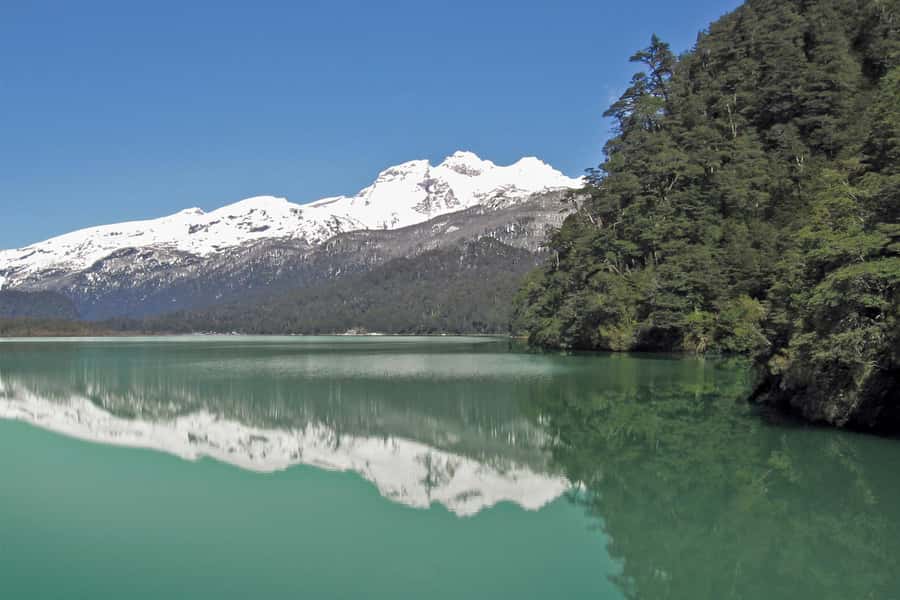
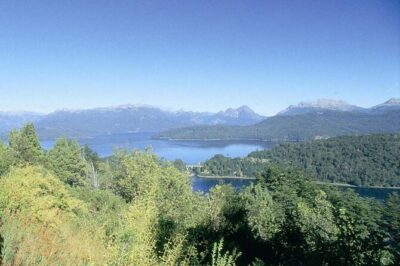
The first catamaran ride lasts about one hour. The boat heads west over the clear waters of Nahuel Huapi, one of the great pleasures of the trip. The lake gives you a broad sense of Patagonia’s scale: open water, distant mountain forms, and a route that feels far removed from Bariloche’s streets.
Keep an eye out for Centinela Islet. The remains of Francisco Pascasio Moreno are there. Moreno, often known as Perito Moreno, played a major role in the creation of Argentina’s national park system, so this small island links the scenery to the country’s conservation story.
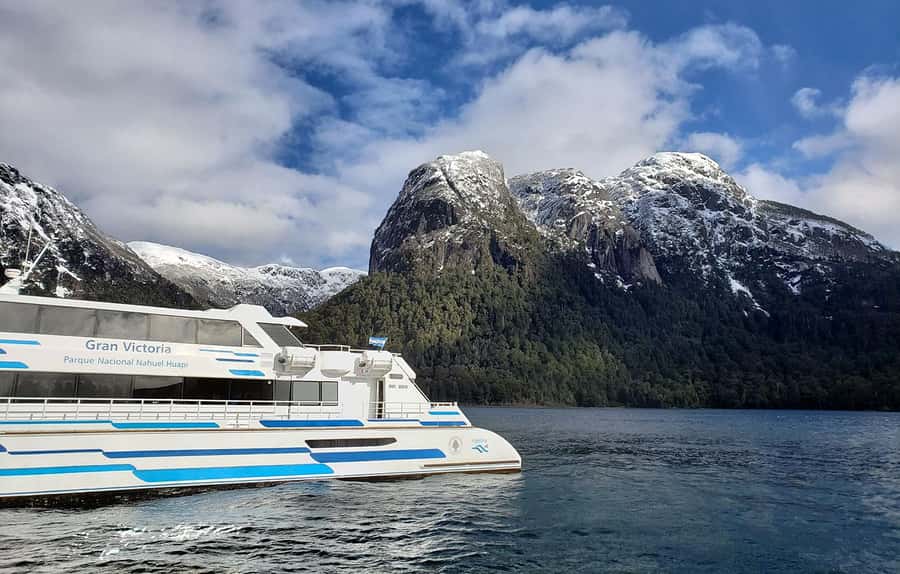
The boat is not simply a shuttle. It is the first major viewing platform of the day. You can watch the shoreline change as the catamaran moves toward the wetter forest around Puerto Blest. The clear water is a central part of the experience, and the hour gives you enough time to settle into the pace of the day.
Still, remember that this is shared transport. A full boat can make the ride feel less peaceful than the setting suggests. If you want the best views, stay alert when the boat leaves and choose your position according to the weather and available seating. The published schedule does not promise a particular side of the catamaran, so flexibility helps.
Walking to Cascada de los Cántaros
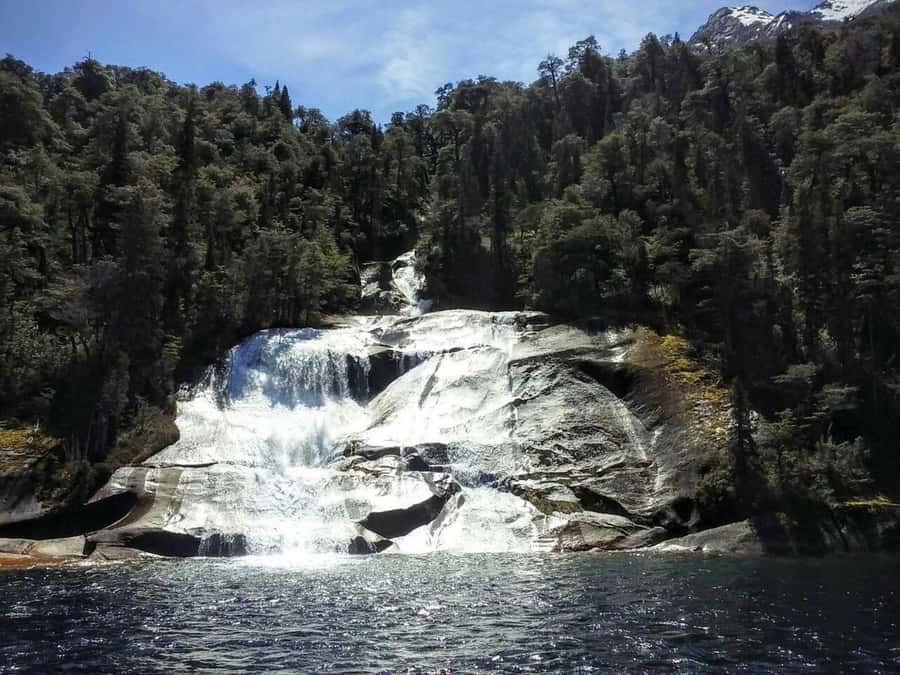
The main land visit lasts about three hours, including a guided visit and free time. The focus is Cascada de los Cántaros, a waterfall in the Valdivian rainforest.
The walk takes you among old larch trees and thick plant growth. This is a different side of the Lake District from the open water. The forest feels enclosed and damp, while the lake crossing feels broad and airy. That contrast gives the excursion its shape.
The trail continues toward Cantaros Lake, the source of the waterfall. The water comes from the region’s clean mountain system before dropping through the forest. You are not just viewing a waterfall from a roadside lookout. You are walking toward the lake that feeds it, which gives the stop a stronger sense of place.
The word walk matters here. You should be comfortable spending time on a forest route rather than treating the stop as a quick photo break. The exact trail conditions and difficulty are not specified, so I would wear sturdy shoes and bring a light waterproof layer. That is sensible advice for a rainforest setting, not a guarantee about the weather.
You receive a guided visit, and audio guide support is included. The guide is meant to add context about the plants, water, and national park setting. Spanish, English, and Portuguese are offered, but the quality of spoken English may vary. One English-speaking booking experience found that the guide spoke very little English, so you should not book this solely for detailed English interpretation.
That said, the waterfall and forest do not depend entirely on commentary. If the guide’s English is limited, you can still appreciate the setting, the old trees, and the route to Cantaros Lake. For Spanish and Portuguese speakers, the language arrangement may be more dependable.
Puerto Blest and the short crossing to Lake Frias
After the waterfall visit, the boat ride to Puerto Blest lasts about 10 minutes. It is a short transfer, but it changes the rhythm again. Puerto Blest provides time to explore a picturesque bay and see the shores of Lake Frias.
Lake Frias is fed by glaciers on Cerro Tronador. The mountain marks the natural border between Argentina and Chile, and its glacial water gives the lake its green color. This is one of the most distinctive details of the trip. You are not simply seeing another lake. You are seeing water shaped by ice high on a major mountain.
The visit to Puerto Blest lasts about one hour and includes a guided component. The stop is more about atmosphere and views than a long independent hike. You can use the time to look across the bay, follow the shoreline, and absorb the quieter setting.
A useful point is that walking between Puerto Blest and the waterfall may be possible on some arrangements, but the standard schedule uses the catamaran for the short connection. Ask locally if an alternative walking route is available and suitable that day. Do not assume you can replace the boat ride without checking, since the timing is organized around the group’s return.
This is also where the excursion’s organization matters. A poorly coordinated departure can take some shine off a beautiful place. Keep your ticket, meeting instructions, and return time easy to reach. The bay is the sort of place where you want to watch the water, not spend your hour trying to find the group.
Still Argentina, but a completely different sort of afternoon:
- San Martín de los Andes por 7 Lagos
★ 4.4 · 155 reviews - Circuito Chico
★ 4.5 · 146 reviews - Bariloche: Circuito Chico and Campanario Hill
★ 4.6 · 83 reviews - Bariloche: Half-Day Small Circuit Tour with Mount Campanario
★ 4.6 · 64 reviews
Returning across the lake
The return catamaran ride takes about one hour, followed by another 45-minute van transfer to Bariloche. By the end of the day, you will have spent a substantial amount of time in transit, but the boat rides are part of the attraction rather than dead time.
The return crossing gives you a second chance to enjoy Nahuel Huapi from a different light. It also gives you a quiet pause after the forest walk and Puerto Blest visit. If the weather changes, the lake can feel entirely different on the way back, so bring a layer you can add or remove.
Drop-off is offered at the same group of locations used for pickup, including central Bariloche hotels and properties along Bustillo Avenue. One useful practical detail is that a coach may sometimes take you directly to your hotel rather than returning you only to the original pickup point. This is not something I would count on, but it can make the end of the day easier.
The total duration is listed as seven hours. The actual feel of the day depends on boat loading, hotel pickups, and group organization. Allow extra flexibility around dinner or other evening plans.
Is $218 a fair price?
The answer depends on what you value. The trip includes the main navigation ticket, a guide, audio guide support, and round-trip transfer arrangements. It also bundles the waterfall, Puerto Blest, and Lake Frias into one day. If you would otherwise need several separate bookings, that can justify part of the cost.
But the added fees change the calculation. You should expect roughly another $25 for National Park admission and boarding, paid locally. That puts the practical cost above the advertised figure.
The trip can feel expensive because the boat and the scenery do much of the work. You are not paying for a long, activity-packed program at each stop. You are paying for access to a beautiful but spread-out part of the Lake District, plus the convenience of a planned route.
I would call it reasonable only if you specifically want Puerto Blest and Cascada de los Cántaros in one organized outing. If you mainly want a scenic boat ride, the price may feel steep. If you prefer total independence, getting to Puerto Pañuelo on your own and arranging the lake visits directly may offer better control, though you would need to handle the timing yourself.
Who will enjoy this day most?
I would recommend this excursion to you if you want a full day outside Bariloche without renting a car or piecing together several transfers. It suits people who enjoy scenery, moderate walking, and guided context more than fast-paced sightseeing.
It is also a good fit if you want variety. The day moves from urban hotel pickup to lake travel, then rainforest, waterfall, glacial water, and mountain-border scenery. You get several distinct settings without repeating the same type of stop.
You may want to think twice if you dislike group transport or crowded boats. The van can collect people going to different excursions, and the organization may not feel polished at every stage. You should also be cautious if detailed English guiding is essential.
Bring comfortable walking shoes, water, sun protection, and a rain layer. The information provided does not specify meal arrangements, so plan around that rather than assuming food is included. Keep cash or a debit card available for the park and boarding charges.
Free cancellation is available up to 24 hours before departure, and you can reserve now and pay later. Those terms are useful if your weather plans are uncertain, but they do not remove the need to check the starting time and pickup point before the day begins.
Should you book Puerto Blest and Cascada de los Cántaros?
Book it if you want the complete combination: Nahuel Huapi by catamaran, a rainforest walk to Cantaros Lake, Cascada de los Cántaros, Puerto Blest, and Lake Frias. The waterfall and boat journey are the strongest parts, and the scenery gives you a memorable look at the wetter western side of the park.
Skip it if $218 already feels high before the extra fees, or if you need consistently strong English commentary. You may also prefer an independent plan if you want to avoid mixed groups and control how long you spend at each stop.
For the right person, this is a beautiful day with real variety. Just treat it as a scenic nature excursion with some organizational compromises, not as a cheap boat transfer or a perfectly polished luxury tour.
FAQ
How long does the Puerto Blest and Cascada de los Cántaros excursion last?
The excursion lasts about seven hours, including the van transfers, catamaran rides, guided visits, and free time.
Where does pickup take place?
Pickup is available from selected central Bariloche hotels and meeting points along Bustillo Avenue, including the Turisur office on Mitre Street, the Sheraton Hotel, Hotel NH Edelweiss, Hotel Tres Reyes, and several hotel gates from kilometer 1 to kilometer 11.5.
What languages are offered?
Live guiding is offered in Spanish, English, and Portuguese. An audio guide is also included, although the amount of spoken English may vary by departure.
Are National Park fees included?
No. National Park entry costs approximately $20 and must be paid at the site, in cash or by debit.
Is the catamaran ticket included?
The navigation ticket is included. A separate boarding fee of approximately $5 is payable locally in cash or by debit.
Can I cancel the booking?
You can cancel up to 24 hours before the activity for a full refund. You can also reserve the activity and pay later, which keeps your plans flexible.
Recently added around San Carlos De Bariloche
- Navigation through Isla Victoria and Bosque de Arrayanes★ 4.4 · 9 reviews
- From Bariloche: Half-Day Circuito Chico Sightseeing Tour★ 4.3 · 9 reviews
- From Bariloche: San Martin de los Andes and 7 Lakes Circuit★ 4.6 · 22 reviews
- From Bariloche: Chico Circuit & Colonia Suiza Tour★ 4.4 · 35 reviews
- Crossing to Puerto Blest and Cascada de los Cántaros★ 4.4 · 5 reviews
- Bariloche: Cerro Tronador and Ventisquero Negro Glacier Tour★ 4.8 · 24 reviews
- Bariloche: Tour to Circuito Chico + Optional: Arrayanes★ 4.2 · 3 reviews
- Bariloche: Victoria Island and Arrayanes Forest Navigation★ 3.4 · 7 reviews
Bariloche Tours, compared.
German Footprint & Nazi presence – Walking Tour in Bariloche
Read our review →
Bariloche Small Circuit: Mt Campanario and Llao Llao Peninsula
Read our review →Browse the lists this tour appears in